
Showing posts with label Steve Holland. Show all posts
Showing posts with label Steve Holland. Show all posts
Monday, January 22, 2024
Borack Captures Holland
Earlier today, Michael Stradford, the author of several books about ubiquitous American paperback cover model Steve Holland, posted a selection of captivating paintings by Brooklyn-born artist Stanley Borack (1927-1993). “He had a crisp, realistic style that captured emotion and movement convincingly,” Stradford writes of Borack. “As such, it makes sense that Steve Holland was his go-to model for many years of paperback and magazine cover work.” As Stradford concludes, they “made a dynamic team.”


Wednesday, February 22, 2023
Softcover Standout
Michael Stradford, author of the 2021 book Steve Holland: The World’s Greatest Illustration Art Model, has completed a new account of Holland’s numerous artistic appearances. Titled Steve Holland: Paperback Hero, it will be introduced at the Vintage Paperback Show in Glendale, California, on March 19. Wider circulation is to follow, though I can find no purchasing information yet.
Tuesday, August 9, 2022
Casting a Wide Net for Links
• Raymond Johnson’s art featured regularly on mid-20th-century paperback covers, particularly those in the crime- and science-fiction categories. I’ve showcased Johnson’s paintings a number of times in Killer Covers, but have always been curious to know more about the artist himself. So I was excited to hear that Rubén “DaCollector” Azcona, a regular contributor to the private Today’s Inspiration Facebook Group page, would be conducting a YouTube interview with Lowell Wilson, author of a beautiful new feature in Illustration Magazine about Johnson. Their exchange can now be seen here in its 2.5-hour entirety. Wilson shares myriad examples of Johnson’s work, some of which graced more than one paperback front, and a few I didn’t know were done by Johnson. Promptly after watching this interview, I ordered a copy of the Illustration Magazine (#77) in which Wilson’s profile appears. How could I pass it up?
• I love it when the blog Pulp International delivers its irregular cover-theme posts. The latest one collects “vintage paperback covers featuring characters on both the giving and receiving ends of knives—or knifelike tools such as icepicks.”
• Speaking of art themes, Paperback Palette blogger Jeff Christoffersen looks back here at artist Rudy Nappi’s many Nancy Drew (ND) covers. As he explains, “In 1952, Rudy Nappi was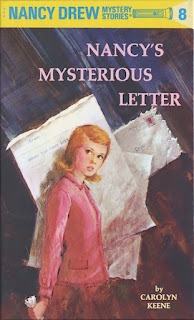 assigned by publisher Grosset & Dunlap to create cover art for their original Nancy Drew Mystery Stories. He concluded his stint in 1979 with what is considered to be the final volume in the original series, volume 56. … Nappi tried to honor the original existing cover art wherever he could, while also updating Nancy’s look as per his publisher’s instructions. Eventually, he followed his own instincts, and his wife’s, who actually read the books on his behalf, composing new scenes for some titles, and on others actual montages, a first for the series. Nappi painted most of these with gouache on board. Along a similar vein, and coinciding with the ND’s, Nappi produced more than 58 of the original Hardy Boys series covers for the same publisher.”
• For the blog Kevin’s Corner, author James R. Benn relates some of the history behind the covers featured on his World War II-era Billy Boyle books, including the 17th and latest installment, From the Shadows, due out next month from Soho Crime.
• Here’s another good reason to go on living! Robert Deis and Wyatt Doyle, who have already published handsomely illustrated volumes about artists Samson Pollen and Mort Künstler, are preparing to release a new book focused on Brooklyn-born painter George Gross (1909-2003). Gross, writes Deis, “was one of the greatest of the many great illustration artists who created cover and interior illustrations for the men’s adventure magazines … In the 1950s, 1960s and 1970s, Gross was also a top cover artist for paperbacks.” The authors debuted George Gross: Covered at the recent PulpFest in Pittsburgh, but haven’t yet made it available on Amazon, Book Depository, or other sales sites. Deis says he’ll post a preview of the work in his blog soon. Watch for it!
• Finally, Michael Stradford, the man behind Steve Holland: The World’s Greatest Illustration Art Model and Steve Holland: Cowboy, reminds us that not only did Holland serve as the model for “Doc Savage, The Spider, The Phantom, The Avenger, countless cowboys and other iconic fiction characters,” but he was also cast as “television’s first ‘Flash Gordon.’” Holland, of course, filled the boots of comic-strip artist Alex Raymond’s space adventurer in the DuMont Network’s 1954-1955 series Flash Gordon. If you’ve never seen any of that show’s 39 half-hour episodes, you’re in luck: Stradford has embedded a colorized example in his post here.
• I love it when the blog Pulp International delivers its irregular cover-theme posts. The latest one collects “vintage paperback covers featuring characters on both the giving and receiving ends of knives—or knifelike tools such as icepicks.”
• Speaking of art themes, Paperback Palette blogger Jeff Christoffersen looks back here at artist Rudy Nappi’s many Nancy Drew (ND) covers. As he explains, “In 1952, Rudy Nappi was
 assigned by publisher Grosset & Dunlap to create cover art for their original Nancy Drew Mystery Stories. He concluded his stint in 1979 with what is considered to be the final volume in the original series, volume 56. … Nappi tried to honor the original existing cover art wherever he could, while also updating Nancy’s look as per his publisher’s instructions. Eventually, he followed his own instincts, and his wife’s, who actually read the books on his behalf, composing new scenes for some titles, and on others actual montages, a first for the series. Nappi painted most of these with gouache on board. Along a similar vein, and coinciding with the ND’s, Nappi produced more than 58 of the original Hardy Boys series covers for the same publisher.”
• For the blog Kevin’s Corner, author James R. Benn relates some of the history behind the covers featured on his World War II-era Billy Boyle books, including the 17th and latest installment, From the Shadows, due out next month from Soho Crime.
• Here’s another good reason to go on living! Robert Deis and Wyatt Doyle, who have already published handsomely illustrated volumes about artists Samson Pollen and Mort Künstler, are preparing to release a new book focused on Brooklyn-born painter George Gross (1909-2003). Gross, writes Deis, “was one of the greatest of the many great illustration artists who created cover and interior illustrations for the men’s adventure magazines … In the 1950s, 1960s and 1970s, Gross was also a top cover artist for paperbacks.” The authors debuted George Gross: Covered at the recent PulpFest in Pittsburgh, but haven’t yet made it available on Amazon, Book Depository, or other sales sites. Deis says he’ll post a preview of the work in his blog soon. Watch for it!
• Finally, Michael Stradford, the man behind Steve Holland: The World’s Greatest Illustration Art Model and Steve Holland: Cowboy, reminds us that not only did Holland serve as the model for “Doc Savage, The Spider, The Phantom, The Avenger, countless cowboys and other iconic fiction characters,” but he was also cast as “television’s first ‘Flash Gordon.’” Holland, of course, filled the boots of comic-strip artist Alex Raymond’s space adventurer in the DuMont Network’s 1954-1955 series Flash Gordon. If you’ve never seen any of that show’s 39 half-hour episodes, you’re in luck: Stradford has embedded a colorized example in his post here.
Tuesday, May 17, 2022
Bouquets for Bama: The Reality of McCoy
Part of a posthumous salute to artist James Bama.
Here’s a record few people can hope to rival: Australian author Leonard Frank Meares (1921-1993) published 746 novels during his career. What’s more, notes the blog Pulp International, “he didn’t even see his first on the shelf until he was thirty-four—young for publishing one’s first novel, but not for publishing the first of 746. Or better yet—look at it this way: that’s an average of just more than nineteen novels every year until he died at age seventy-two.”
Obviously, Meares wasn’t one to wasting time behind his typewriter. “Len never needed more than 24 hours to devise a new plot,” explains David Whitehead (aka Ben Bridges), author and co-founder (with Mike Stotter) of Britain’s Piccadilly Publishing, which has re-reissued some of that prolific Aussie’s works over the years. He goes on to quote Meares as remarking, “Irving Berlin once said that there are so many notes on a keyboard from which to create a new melody, and it’s the same with writing on a treadmill basis.” It wasn’t unheard of for Meares to pen 30 books in 12 months!
Most of those were westerns, released under pseudonyms such as Marshall Grover, Johnny Nelson, Shad Denver, and Ward Brennan. In 1956, his 10th novel, Drift, came out Down Under, starring “his fiddle-footed knights-errant, Larry Valentine and Stretch Emerson, the characters for which he would eventually become so beloved,” as Whitehead recalls. Then, eight years on, Meares welcomed to print The Night McLennan Died, “the first of more than 70 oaters to feature cavalryman-turned-manhunter Big Jim Rand.”
“The [Rand] series started in 1964,” explains Michael Stradford, a book-art blogger and the director of Creative Content for Warner Home Entertainment, “and told the story of former cavalry sergeant Big Jim Rand, who abandoned the military to go on a mission of revenge to find the gambler who shot and killed his brother.” Stradford adds that about halfway through the series—which was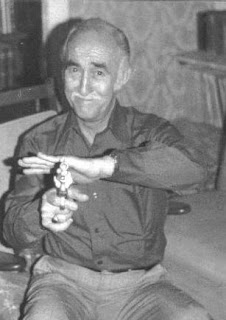 credited to Marshall Glover—“Big Jim found his brother’s killer and settled that account before heading off to new adventures.”
(Left) Leonard F. Meares
Recognizing that it had hit a gold mine with the prolific Meares, his Australian publisher at the time, the Horwitz Group, sold America’s Bantam Books the rights to more than 30 of his short novels. As the story goes, though, legal reasons compelled Bantam to change both author and character names. Thus, “Marshall Grover” became “Marshall McCoy,” “Larry and Stretch” was modified to “Larry and Streak,” and “Big Jim Rand” was rechristened “Nevada Jim Gage.”
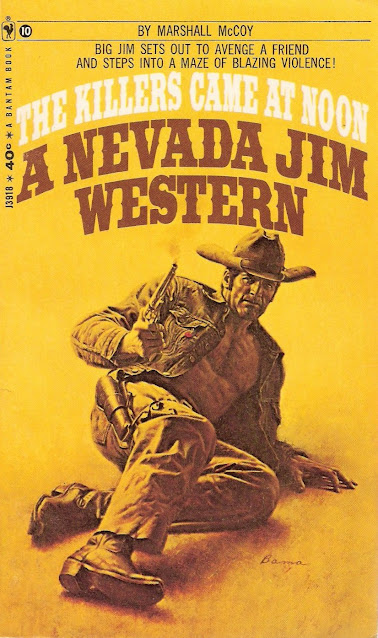
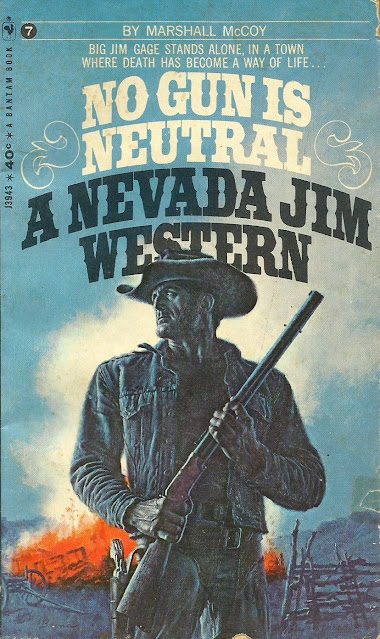
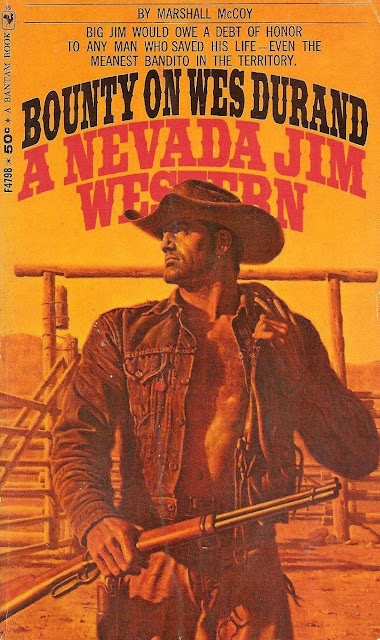
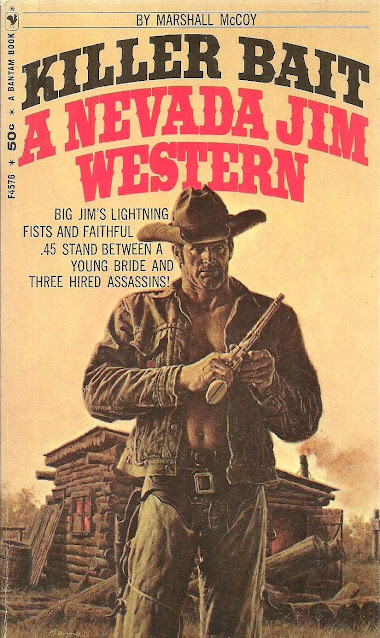
Bantam commenced issuing the Nevada Jim adventures in 1968, with cover art by James Bama. “Bama brought [model Steve] Holland in to pose as Nevada Jim, although he changed the likeness quite a bit in some illustrations and made Jim look more like Holland in others,” says Stradford, who studied the Nevada Jim series in preparation for writing his 2021 book, Steve Holland: The World’s Greatest Illustration Art Model (Primedia). “He also packed a lot of muscle on Jim in the paintings. Using similar color schemes that could often be found on his Doc Savage covers, Bama essentially offered ‘Doc out west’ but still managed to make the illustrations fresh and exciting. So much so, that several of the paintings were repurposed for a variety of other western novels, including a few by Louis L’Amour.”
According to veteran Texas author James Reasoner, 1968’s Big Lobo was the first Nevada Jim novel to reach U.S. bookshops, though it was “actually the thirtieth book in the original Big Jim series.” Reasoner says of Meares’ work: “[N]obody could pack more plot twists and back-story into 35,000 words than Len Meares. Almost nothing is what it seems, because Meares was a master at taking standard western situations and turning them upside-down. He didn’t do this in all his books, of course. … Many of them, though, have intriguing characters who turn out to be not at all what you expect when you start reading the novels, and that’s true of Big Lobo.”
Bantam issued softcover editions of at least 16 Nevada Jim yarns, fronted by Bama artwork. Surprisingly, they’re still fairly easy to find for sale, either in second-hand bookstores or online. I can’t say I own any, but I have several cover images in my computer files—which I am sharing here. The Killers Came at Noon, Limbo Pass, and No Gun Is Neutral are all said to have been released in 1968, with Bounty on Wes Durand and Killer Bait dated to the following year.
In case you’re curious, Meares passed away in New South Wales, Australia, on February 4, 1993, after being hospitalized with viral pneumonia. He was 72 years old, but could rightly be said to have produced enough books for a man twice his age.


Here’s a record few people can hope to rival: Australian author Leonard Frank Meares (1921-1993) published 746 novels during his career. What’s more, notes the blog Pulp International, “he didn’t even see his first on the shelf until he was thirty-four—young for publishing one’s first novel, but not for publishing the first of 746. Or better yet—look at it this way: that’s an average of just more than nineteen novels every year until he died at age seventy-two.”
Obviously, Meares wasn’t one to wasting time behind his typewriter. “Len never needed more than 24 hours to devise a new plot,” explains David Whitehead (aka Ben Bridges), author and co-founder (with Mike Stotter) of Britain’s Piccadilly Publishing, which has re-reissued some of that prolific Aussie’s works over the years. He goes on to quote Meares as remarking, “Irving Berlin once said that there are so many notes on a keyboard from which to create a new melody, and it’s the same with writing on a treadmill basis.” It wasn’t unheard of for Meares to pen 30 books in 12 months!
Most of those were westerns, released under pseudonyms such as Marshall Grover, Johnny Nelson, Shad Denver, and Ward Brennan. In 1956, his 10th novel, Drift, came out Down Under, starring “his fiddle-footed knights-errant, Larry Valentine and Stretch Emerson, the characters for which he would eventually become so beloved,” as Whitehead recalls. Then, eight years on, Meares welcomed to print The Night McLennan Died, “the first of more than 70 oaters to feature cavalryman-turned-manhunter Big Jim Rand.”
“The [Rand] series started in 1964,” explains Michael Stradford, a book-art blogger and the director of Creative Content for Warner Home Entertainment, “and told the story of former cavalry sergeant Big Jim Rand, who abandoned the military to go on a mission of revenge to find the gambler who shot and killed his brother.” Stradford adds that about halfway through the series—which was
 credited to Marshall Glover—“Big Jim found his brother’s killer and settled that account before heading off to new adventures.”
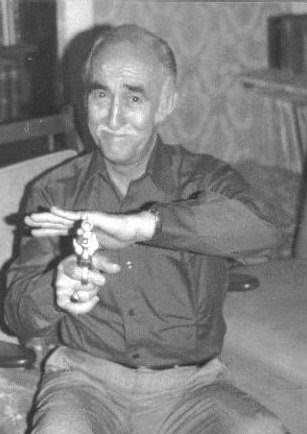
(Left) Leonard F. Meares
Recognizing that it had hit a gold mine with the prolific Meares, his Australian publisher at the time, the Horwitz Group, sold America’s Bantam Books the rights to more than 30 of his short novels. As the story goes, though, legal reasons compelled Bantam to change both author and character names. Thus, “Marshall Grover” became “Marshall McCoy,” “Larry and Stretch” was modified to “Larry and Streak,” and “Big Jim Rand” was rechristened “Nevada Jim Gage.”
Bantam commenced issuing the Nevada Jim adventures in 1968, with cover art by James Bama. “Bama brought [model Steve] Holland in to pose as Nevada Jim, although he changed the likeness quite a bit in some illustrations and made Jim look more like Holland in others,” says Stradford, who studied the Nevada Jim series in preparation for writing his 2021 book, Steve Holland: The World’s Greatest Illustration Art Model (Primedia). “He also packed a lot of muscle on Jim in the paintings. Using similar color schemes that could often be found on his Doc Savage covers, Bama essentially offered ‘Doc out west’ but still managed to make the illustrations fresh and exciting. So much so, that several of the paintings were repurposed for a variety of other western novels, including a few by Louis L’Amour.”
According to veteran Texas author James Reasoner, 1968’s Big Lobo was the first Nevada Jim novel to reach U.S. bookshops, though it was “actually the thirtieth book in the original Big Jim series.” Reasoner says of Meares’ work: “[N]obody could pack more plot twists and back-story into 35,000 words than Len Meares. Almost nothing is what it seems, because Meares was a master at taking standard western situations and turning them upside-down. He didn’t do this in all his books, of course. … Many of them, though, have intriguing characters who turn out to be not at all what you expect when you start reading the novels, and that’s true of Big Lobo.”
Bantam issued softcover editions of at least 16 Nevada Jim yarns, fronted by Bama artwork. Surprisingly, they’re still fairly easy to find for sale, either in second-hand bookstores or online. I can’t say I own any, but I have several cover images in my computer files—which I am sharing here. The Killers Came at Noon, Limbo Pass, and No Gun Is Neutral are all said to have been released in 1968, with Bounty on Wes Durand and Killer Bait dated to the following year.
In case you’re curious, Meares passed away in New South Wales, Australia, on February 4, 1993, after being hospitalized with viral pneumonia. He was 72 years old, but could rightly be said to have produced enough books for a man twice his age.


Friday, April 29, 2022
Bouquets for Bama: A Preview

(Above) The Midas Man, by Kenneth Robeson (Bantam, 1960), featuring artist’s model Steve Holland.
Following artist James Bama’s demise on April 24—just four days short of what would have been his 96th birthday—tributes to his work and longevity flooded the blogosphere and social media outlets.
“James Bama enjoyed several memorable careers as an illustrator, but [he] was arguably best known for his 60+ paintings of Bantam’s paperback series revival of Doc Savage, featuring his good friend, model Steve Holland as his subject,” recalled Michael Stradford, a director of Creative Content for Warner Home Entertainment and the author of last year’s beautiful release, Steve Holland: The World’s Greatest Illustration Art Model (Primedia).
“While there are dozens, maybe scores, of authors who have influenced me, I think there are only a handful of artists who made me who I am today,” added
 prolific fictionist James Reasoner. “James Bama was certainly one of them. My discovery of the Doc Savage series really made me aware of the pulps for the first time and started my on-going love affair with them.”
(Right) Bantam’s The Man of Bronze (1964), with cover art by James Bama.
“His vision of Doc Savage was a huge part of my childhood (and ongoing) obsession with the character,” wrote novelist Win Scott Eckert. “While I understand that [Walter M.] Baumhofer’s portrayal of Doc on the original 1930s pulp magazine covers may be more accurate, when I read Doc novels, I see Bama’s version in my mind’s eye. I can’t help it.”
Such praise didn’t come unearned.
The story goes that James Elliott Bama was born on April 28, 1926, in Washington Heights, then a booming middle-class neighborhood of New York City’s Manhattan borough. He demonstrated an early interest in and aptitude for artistic pursuits, honing his talents by copying the comic strips of Alex Raymond (Flash Gordon) and Hal Foster (Tarzan). “I was four months shy of eight years old when Flash Gordon came out in 1934 and I kept copies of that comic strip for 10 years, until I was 18,” Bama told the blog MensPulpMags.com in 2014. “I’d go to the candy store every Sunday and wait for the newspaper truck to come. I must have known how good he would be. Alex Raymond grew and grew and grew as an artist. He was incredible, and he was my first hero. I loved Hal Foster’s comic strips, too. In fact, I originally wanted to be a cartoonist.”
“As a teenager,” recalls an obituary, Bama “attended the Fiorello LaGuardia High School of Music and Art. His father died suddenly when Jim was fourteen, and since his mother had become an invalid after a stroke, he had to work after school and do the housecleaning.” The United States entered World War II in 1941, when Bama was only 15. He had to wait three more years, until 1944, to enlist in the Army Air Corps, “and was trained as a navigator and stationed in several southern states. The war ended before he would have gone overseas, but he still qualified for the G.I. Bill, and thus was able to go to the Art Students League, where he studied under the illustrator Frank J. Reilly.”
Once done with art school, Bama began soliciting commissions for illustrations, including assignments from paperback book publishers. His first cover art was for the 1949 Avon release A Bullet for Billy the Kid, by Nelson Nye—the project that introduced him to Steve Holland, a TV actor and model whose
,%20Avon%201950%20-%20illus%20James%20Bama.jpg) image would later grace myriad Bama covers. In 1951 the artist started a 15-year stint with New York’s Charles E. Cooper Studios, described in the book History of Illustration (2019) as “a renowned agency specializing in glamour illustration for advertising and women’s magazines … The illustrators received 50 percent of each advertising commission secured by the company’s account executives.” Wikipedia explains that “Bama had a 22-year career as a successful commercial artist, producing paperback book covers, movie posters and illustrations for such publications as Argosy, The Saturday Evening Post and Reader's Digest, and his numerous clients included the New York Giants football team, the Baseball and Football Halls of Fame and the U.S. Air Force.” He also created illustrations for such men’s adventure magazines as Stag, For Men Only, and Male.
image would later grace myriad Bama covers. In 1951 the artist started a 15-year stint with New York’s Charles E. Cooper Studios, described in the book History of Illustration (2019) as “a renowned agency specializing in glamour illustration for advertising and women’s magazines … The illustrators received 50 percent of each advertising commission secured by the company’s account executives.” Wikipedia explains that “Bama had a 22-year career as a successful commercial artist, producing paperback book covers, movie posters and illustrations for such publications as Argosy, The Saturday Evening Post and Reader's Digest, and his numerous clients included the New York Giants football team, the Baseball and Football Halls of Fame and the U.S. Air Force.” He also created illustrations for such men’s adventure magazines as Stag, For Men Only, and Male.Bama’s reputation as a hyper-realistic painter helped win him the commission, in the early 1960s, to provide cover art for a brand-new softback line of Doc Savage editions issued by Bantam Books. The hero protagonist of those pulpy tales (real name Clark Savage Jr.) was a scientist, doctor, martial artist, inventor, and “master of disguise” who “rights wrongs and punishes evildoers.” He was initially introduced in the March 1933 edition of Doc Savage Magazine, a Street & Smith periodical. Doc’s developers were publisher Henry W. Ralston and editor John L. Nanovic, but his printed escapades were credited to “Kenneth Robeson,” a house pen name behind which hid a melange of scribblers, most notably Lester Dent, who was involved with the series through 1949.
In 1964, Bantam purchased rights to the Doc Savage yarns and the company’s art director, Len Leone, hired Bama to portray their lead character—now sporting a distinctive widow’s peark—on a fresh line of releases. Bama, in turn, recruited Steve Holland as his cover model. He eventually “painted 62 of the first 67 covers with mind–blowing vigor and meticulousness,” says ThePulp.Net. “Every one of those covers is a miniature masterpiece to be marveled at.”
Between doing Doc Savage fronts, Bama fit in his work for other American paperback publishers. His burgeoning portfolio soon included paintings for mystery, romance, western, and historical novels, as well as non-fiction titles. Authors as diverse as James M. Cain, Stewart Sterling, Louis L’Amour, Mary Shelley, James Jones, Philip Roth, Joan Didion, Gustave Flaubert, and William Goldman benefited from his expertise. The artist even created the art for a rather well-known early entry in the Star Trek tie-in series.
But Jim Bama had wearied of the hard-scrambling Manhattan scene. In 1964 he wed Lynne Klepfer, a New York University art history major whom he’d met the year prior, and had engaged as a book-cover model. Four years on, the couple relocated to Cody, Wyoming, and subsequently purchased a home in not-far-distant Wapiti. It was there that Bama started painting contemporary western scenes and subjects, working on his own fine art during the day,
 while laboring at night for publishers. “I never came out here with the idea to be a western artist,” Bama has been quoted as saying. “It just happened, and that’s the way it should be.”
(Right) Little Star, Bama’s portrait of a “beautiful Navajo maiden.”
By 1971, Bama had hooked up with art dealers in New York, and turned his focus from paperback cover art to painting likenesses of Native Americans, cowboys, and buffaloes. Over the next three decades, he generated one arresting canvas after the next. Of a one-man show Bama mounted at Gotham’s august Coe Kerr Gallery, art critic Gerrit Henry opined:
Bama’s is western art that any self-respecting art critic is automatically required to sneer at. But it’s hard to sneer. In a supernaturalistic style that makes New York Photo Realism look like Action Painting, Bama paints heroes of the contemporary West. … He takes the true stuff of American myth, Olympian figures of a dying past, and reinstates them in our cultural consciousness …Sadly, Bama’s eyesight began to decline in the early 2000s, and he was compelled to forsake painting after a half-century-long career. His work remained popular, though, thanks in part to examples of his artistry being collected in book form. The Western Art of James Bama was released in 1975, followed by James Bama: American Realist (2006) and James Bama: Personal Works (2012).
Reports are that when Bama passed away last weekend, it was at his Wyoming home. He was soon afterward cremated.
Looking back, I’m surprised to discover that Jim Bama’s artistic virtuosity has been celebrated only twice before on this page, once in a round-up of his “teenager-in-torment” paperback fronts, and again for his art fronting a 1967 book about James Bond creator Ian Fleming. That changes today. In tribute to the talents of this late, great American painter, I’m readying a series of posts that display a breadth of his illustrative efforts, not only book fronts but also magazine spreads and even his box art for monster model kits. The opening installment will appear this coming Monday, May 2, with more entries set to roll out over the next two weeks.
Stay tuned.
Subscribe to:
Posts (Atom)





