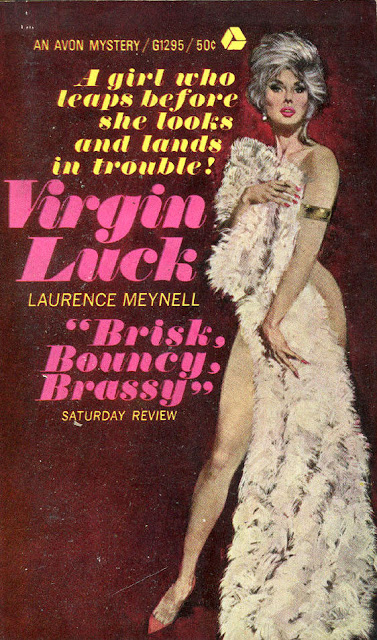
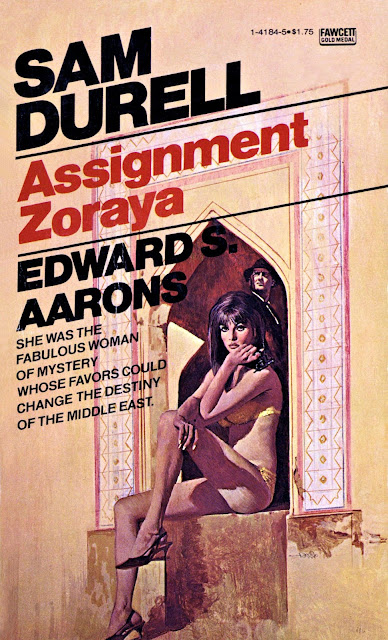
 Assignment Zoraya, by Edward S. Aarons (Fawcett Gold Medal, 1977). Deadly Dames and Sexy Sirens explains that when Ron Lesser’s painting was printed on this novel, “the image was flipped, which is why his signature is backwards.”
This is the first time my byline has appeared on the front of a book without my expecting to find it there. The work in question is
The Art of Ron Lesser Volume 1: Deadly Dames and Sexy Sirens, a gorgeous, full-color collection of 81-year-old artist Ron Lesser’s classic paperback and movie poster art. It was published late last month, and has already won
a flurry of favorable critical responses.
According to Robert Deis, a South Florida authority on the art of vintage men’s adventure magazines, it was
a lengthy 2018 interview I conducted with Lesser for Killer Covers that gave him the idea to create this 145-page book. Together with Bill Cunningham, the Southern California-based head of
Pulp 2.0 Press (and his collaborator on
Men’s Adventure Quarterly magazine), and with Lesser’s enthusiastic approval, they set about gathering together prime examples of the painter’s work from the last six and a half decades. Because they introduce this hardcover book with a slightly edited version of my original interview, I was given a cover credit.
Much to my delight, I should add.
I have a much-prized collection of volumes having to do with paperback cover art and artists, among them Ed Hulse’s
The Art of Pulp Fiction: An Illustrated History of Vintage Paperbacks, Colin Larkin’s
Cover Me: The Vintage Art of Pan Books: 1950-1965, Art Scott’s
The Art of Robert E. McGinnis, and
Mort Künstler: The Godfather of Pulp Fiction Illustrators, which was co-edited by Bob Deis and Wyatt Doyle.
Deadly Dames and Sexy Sirens certainly holds it own with the best of those. Not only is it handsomely illustrated with Lesser’s finished pieces, original art, and some of the model photographs to which he referred when creating his canvasses, but it also features comments from Lesser about his artistic techniques and spreads that highlight a selection of his favorite female models, including his wife of four decades, Claudia. (
Click here to enjoy an online sneak peak at some of this book’s contents.)
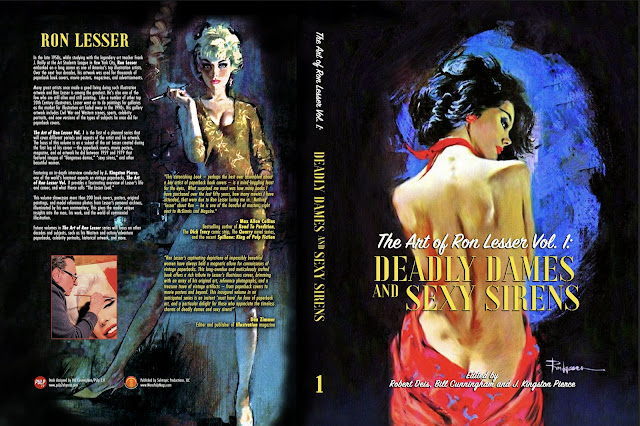 The full cover of Deis and Cunningham’s tribute volume.
Recently I took the opportunity to question Deis and Cunningham—via e-mail—about their new book. The results are quite wide-ranging, and cover everything from their introductions to Ron Lesser’s prolific artistry and their innovative design for
Deadly Dames, to their collaboration process with the book’s subject and the lengths to which they went in acquiring specimens of his work (an endeavor that often drew the aid of South Carolina resident Tim Hewitt, a former tech writer and “web monkey,” now an ardent paperback collector who says he owns “somewhere around 350 books with Lesser covers”).
Amazingly, this study of Lesser’s life and labors is only the initial installment in a planned series of similar tributes. Bob Deis (who also co-edited
a recently released compilation of Lawrence Block’s early stories) says “there could be more than three volumes” to come, exploring differerent periods of the painter’s career and the diversity of literary genres to which he has contributed. Like other old paperback fans, I shall be waiting anxiously to snap those up, too—whether they have my name on their fronts or not.
J. Kingston Pierce: Do you recall how you were introduced to Ron Lesser’s artistry? And what was it about his work that most caught your eye? Are you, perhaps, longtime collectors of his book covers?
Robert Deis: About 20 years ago, I began collecting and studying men’s adventure magazines published in the 1950s, 1960s, and 1970s. That led me to write a blog about them and the artists and writers who worked for them. I sought out and did interviews with a number of those artists and writers who were still alive, and that led to connections with other MAM fans. One of them was Wyatt Doyle, head of the
New Texture indie publishing company. In 2012, Wyatt and I started publishing books that
reprint MAM stories and artwork. We’ve also done a series of art books focusing on particular artists, including
Mort Künstler,
Samson Pollen,
Gil Cohen, and
George Gross.
(Right) Girl from Havana, by Eric Colby
(All Star, 1966).
Most of the artists who did MAM artwork also did paperback cover art. Ron Lesser only did a handful of paintings for MAMs. I was vaguely aware that he was a major paperback cover artist, but it wasn’t until I saw your in-depth interview with Ron in 2018 that I realized just how major. And, it wasn’t until I saw the Lesser covers and artwork in that interview and your later “
Lesser Look” posts that I focused on how great his artwork is. I was struck by how it reflects the beautifully rendered, often dramatically lit, attention-getting style common to other top paperback cover artists, like
James Bama, Frank McCarthy, Robert Maguire, and
Robert McGinnis. When I found out that, unlike those artists, there was no book about Ron’s artwork, I decided to try to fill that void. I contacted him and he was excited about the idea of doing a book.
That’s when I got into collecting books with Lesser cover art in a big way. Since paperback cover art was not a focus of the books I do with Wyatt, I asked book designer and publisher Bill Cunningham if he’d like to do a Lesser art book with me. I’d been working with Bill for about two years on a lushly illustrated magazine that showcases MAM stories and artwork, called the
Men’s Adventure Quarterly, so I asked if he wanted to do a Lesser art book. He said yes—enthusiastically.
Bill Cunningham: To be honest, I wasn’t aware of Ron Lesser as an artist until Bob started sending over paperback covers, and I thought, “OK, this seems familiar.” Then I worked as the designer for Michael Stradford’s book
Steve Holland: The World’s Greatest Illustration Art Model and realized that Ron created the covers for one of my favorite western paperback series,
Fargo. That’s when I had an appreciation for

what he did, as it was based on that emotional connection I had with the Fargo series. I branched out after that.
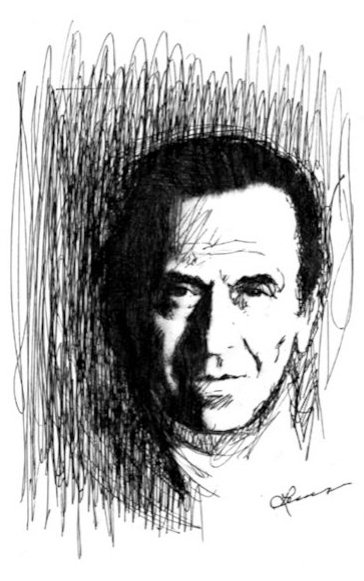
(Left) Lesser’s self-portrait sketch.
JKP: How would you rank Lesser among paperback cover artists?
BC: Obviously, my appreciation for him and his body of work has only grown as I’ve worked on this book. One aspect to the project that we’ve tried to explore is showcasing the man, his work, and the world he worked within. He was able to apply his skills to a variety of media—paperbacks, magazines, advertising, movie posters, and even landscapes and portraiture—and not every artist is able to pull that off. The fact he was skillful, talented, and flexible enough to do that is amazing and should be celebrated far more than it has been.
RD: To me, Ron ranks right up there among the top illustration artists who started out doing paperback cover art in the ’50s and ’60s. Clearly, the art directors at paperback companies felt that way. He did covers for almost every major publisher. I am especially fond of illustration art in the realistic style championed and taught at the
Art Students League of New York, where Ron and many other great artists studied. Artists such as Jim Bama, Stan Borack, Mel Crair, Jack Faragasso,
Roger Kastel,
Robert Maguire, Frank McCarthy,
Lou Marchetti,
Rudy Nappi, Tom Ryan, and Robert E. Schulz.
JKP: How long ago did you decide to put this book together?
RD: We started working with Ron in 2021. After we realized he’d done thousands of book covers and movie posters, we decided a series of books was needed to do justice to Ron’s career.
For the first book, we decided to focus on his early illustration art from the ’50s, ’60s, and ’70s that features sexy women, one of the most common eyeball-grabbing subjects on books covers from those decades. I asked Bill to create a layout that would give a book showcasing vintage covers and artwork a fresh look, and figure out how to intersperse those visual elements with quotes I put together from phone interviews I did with Ron and reference photos he gave us. Bill succeeded far beyond my expectations.
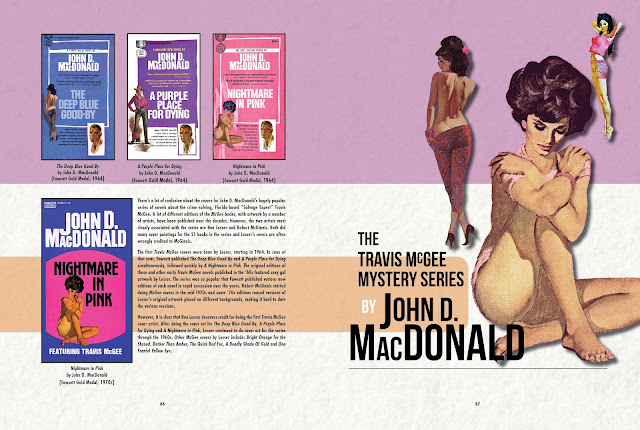 Ron Lesser and Robert McGinnis are the artists most closely associated with John D. MacDonald’s best-selling Travis McGee detective novels. “Both did many cover paintings for the 21 books in the series,” explains Deadly Dames, “and Lesser’s covers are often wrongly credited to McGinnis.”
BC:
Ron Lesser and Robert McGinnis are the artists most closely associated with John D. MacDonald’s best-selling Travis McGee detective novels. “Both did many cover paintings for the 21 books in the series,” explains Deadly Dames, “and Lesser’s covers are often wrongly credited to McGinnis.”
BC: Applying our thoughts to celebrate the man, his work, and the world he worked in, we began to break down how we could accomplish this. We broke it down by years with sub-groupings of series here and there—the Travis McGee books, the
Johnny Liddell series, etc.—and groupings of Ron’s model reference photos. It was comical at times, because we would get to a point where, after I had the layout going, Ron would send us an e-mail with some new piece for the puzzle—a cover we hadn’t seen, a note about a model, or even just an anecdote that would spin us off in a new direction. Then we would get a note from
über paperback collector Tim Hewitt, who kept finding covers that Ron had forgotten about—and that would get the merry-go-round spinning again.
As far as the look of the book, I didn’t ever want to create a book that anyone could make. That is, a book with white pages and the art placed just so. It had to be a book that again reflected the man, the work, and the world. Many of the early pages mimic a mid-20th-century modern design aesthetic (or my version of it, anyway) to showcase that era of his work. We then progress into the “mod” ’60s, the’70s, and onward.
Hopefully, the reader will subconsciously pick up on that and set the artwork within the right framework of time.
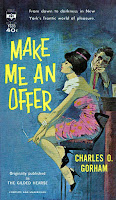
(Right) Make Me an Offer, by Charles O. Gorham (Berkley, 1962).
JKP: What were your initial expectations for this book? Who did you see as your audience?
RD: My interests—vintage paperbacks and magazines—are niches. Luckily, there are enough people interested in those niches that there is now a pretty good following for projects I do with Bill or Wyatt. And, I think books featuring Ron Lesser’s artwork will have broader appeal than say, the
Men’s Adventure Quarterly Bill and I publish. You don’t really have to be a major vintage paperback or illustration aficionado to enjoy Ron’s amazing artwork and read what he says about what it was like to be an illustration artist in the ’50s and ’60s. As I write this, the book has only been available for a couple of weeks via Amazon worldwide, but early sales suggest that it will likely be one of our best sellers.
BC: My initial expectations for any project, whether it’s comics, pulp, or an art book like
Deadly Dames, is to best tell the story that’s presented. If I take care of that first and foremost, I know that I can count on the book to have “legs.” I’m certain this book is going to appeal to paperback collectors, commercial art collectors, and those who appreciate good artwork. We tell Ron Lesser’s story during that period of time between 1959 and 1979. For most people, that would be a full career, but for Ron he was just getting started!
JKP: When did you first go about contacting Long Island, New York, resident Lesser and convincing him to participate in this venture? Did he agree right away to help, or was there arm-twisting Involved?
BC: I didn’t come aboard the project until Bob had already finagled the deal. That made it especially easy for me.
RD: I e-mailed Ron not long after I saw your interview with him on the Killer Covers blog. I told him I had published illustration art books featuring artists he knew, like the book
Mort Künstler: The Godfather of Pulp Fiction Illustrators, and wanted to do a book about him. Naturally, he wanted to see those books before he agreed to anything, so I sent them to him and he liked them. As we talked about my love for illustration artwork and what elements we could showcase in a book about his, I think
.jpg)
he realized we would do justice to his legacy and quickly became enthusiastic. No arm-twisting required.
(Left) Make My Bed Soon, by Jack Webb (Avon, 1965).
JKP: What was your working relationship with Lesser like? How involved was he in bringing this exceptional project to market?
RD: After Ron got on board, he was very heavily involved and very responsive to any requests we had, which were many. He sent us lists of his books, covers scans, anecdotes, photos, and suggestions on a regular basis. He also helped identify book covers as his (or not) that we thought looked like his, but didn’t have his signature. He also very carefully reviewed and weighed in on the layout, and the quotes we used, and sent us new images and quotes along the way as he saw layouts for various pages. For me, it was great fun to talk with Ron and learn about his life and work and what it was like to be an illustration artist during the heyday of illustration art. It was sometimes a bit hard on Bill, since we went through
nine versions of the layout to address his suggestions and additions before it was complete.
BC: Ron is a lovely man, but he can be a bit picky and prickly. He is often overly critical of his own work. He would look at certain pages and say he didn’t like certain covers we wanted to include. Sometimes it was because there was an emotional component to it. Sometimes he didn’t like some minor aspect of a cover. Sometimes he had a different view on how to design certain pages. After a while, I understood that Ron approached every aspect with a critical eye, but didn’t realize that readers would enjoy certain things he didn’t like. For example, I think some of the covers he didn’t want to include for some reason are going to be the covers readers will remember most. Bob interviewed Ron several times, and I sat in with both of them when we reviewed several drafts of the book. My job as the designer was to listen more closely than anyone else and try to understand the nature of Ron’s critical eye on his work. Understand the man and begin to understand the work.
JKP: What’s the most interesting thing you learned about Lesser and his career over the course of putting this book together?
RD: The most amazing thing to me was when I began to realize just how much great artwork Ron has done over the past six decades and how varied it is. Between 1959, when he first became a professional artist, and the 1990s, when the market for high-quality illustration art faded away, he did thousands of paintings for book covers, movie posters, album covers, and ads for TV shows. Then, like many artists who started out in those realms, he went on to do western and Civil War paintings for galleries. He also did sports paintings and in recent years a lot of paintings of old and new female celebrities such as Marilyn Monroe, Bettie Page, Margo Robbie, and Gal Gadot. He’s also been doing new versions of his early paperback cover paintings. In fact, Ron is one of the last of the top mid-20th-century illustration artists who is not only still alive but still painting. He calls himself “the last man standing.” I also learned that Ron is a workaholic. Throughout his long career,
he has worked on some painting virtually every day.
BC: Again, I think it’s the variety within his career. He did a bit of everything and has been doing it well for a very, very long time. That is something to be celebrated.
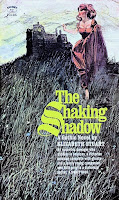
(Right) The Shaking Shadow, by Elizabeth Stuart (Signet, 1967).
JKP: What sort of challenges did you face in gathering all of the art for this volume? My presumption is that Lesser didn’t have most of the paintings you needed, so how did you find everything?
BC: Bob can speak to this better than I can, but Ron provided a wealth of material from his archives. The running joke was we would get a draft done and wait for Ron to find something new in his attic.
RD: One big challenge we faced was that Ron had been incredibly busy and he was so focused on getting paintings done and meeting deadlines, he didn’t keep a record of everything he did. So, we had to piece together the list of Lesser covers from various sources. The Killer Covers posts and
Ron’s Web site provided good starting points. But he did many more covers between ’59 and ’79 than are shown on those. So, I had to do a lot of Googling and a lot of sleuthing on Facebook groups that feature paperback covers.
The other challenge was that many of the old paperbacks Ron did cover art for are hard to find and there weren’t good-quality scans of them online. Luckily, through Facebook, I connected with Tim Hewitt, who has a huge collection of vintage paperbacks and a great eye for IDing the artists. Tim had or searched out and bought scores of books we would not have otherwise had scans of. We also got help from other folks who hang out in those Facebook groups, who had certain books, or who owned original Lesser paintings and gave us photos of them. People such as art dealer Rubén Azcona, artist Joe Jusko, and art collectors Brian Emrich and Jimmy Willis.
JKP: Were there examples of Lesser’s early artistry that you just couldn’t locate, no matter how hard you tried?
RD: Oh, yeah. In fact, almost all of the original paperback cover and movie poster paintings Ron did between 1959 and 1979 are lost in space. They were not returned to him [by the folks who commissioned them], and he was too busy to worry about it at the time. He was focused on getting the next assignment done. And, unfortunately, Ron didn’t think about taking high-quality photos of them for later use. So, we could only find photos of a limited number of his originals from that period that have appeared on online art auction sites or that we were given by a handful of vintage art collectors. In other words, as far as specific examples of his original art are concerned, almost all are missing from the period covered by this first book. The good news is that, starting around 1979, Ron had large-format transparencies shot of his paperback cover paintings, and he gave us hundreds of those to use for Volumes 2 and 3.
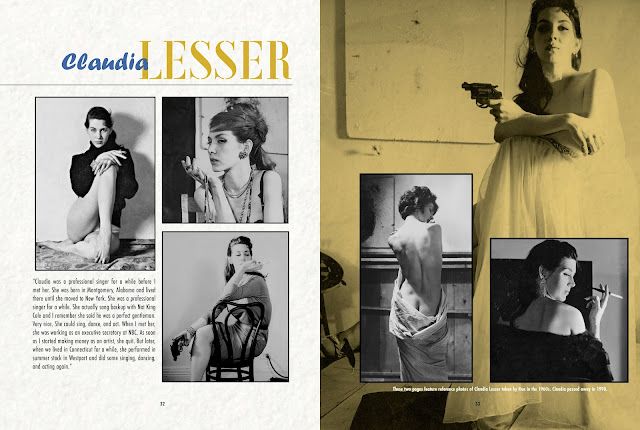 Lesser often used his wife, Claudia, as a model for his paperback cover paintings. Unfortunately, she passed away in 1998.
JKP:
Lesser often used his wife, Claudia, as a model for his paperback cover paintings. Unfortunately, she passed away in 1998.
JKP: How did you choose the two Lesser paintings that made the front and back of this book? Did you know from the outset that those were going to be on the covers?
RD: Bill chose the front cover art, and Ron and I loved his choice. It’s Ron’s original painting for the 1962 Lancer paperback
Curtains for a Lover, by Robert Dietrich, a pseudonym for Watergate conspirator and prolific novelist
E. Howard Hunt. The model was Ron’s wife, Claudia, which made it doubly cool to me. Bill’s initial pick as artwork for the back cover turned out to be one of the ones Ron didn’t think was one of his best, so Bill suggested the painting Ron did for the 1965 novel
The April Robin Murders, by Craig Rice and
Ed McBain, and that was blessed by Ron. The model was
Lisa Karan, one of his favorites in the ’60s other than his wife.
BC: The front cover has always been the front cover. From a design perspective, how could you go wrong with a single subject, brightly colored on a black background? You can recognize the cover immediately from yards away. The back cover changed when Ron didn’t like my choice of
Crime of Their Life, by
Frank Kane (Dell, 1962), because he thought the image looked “cartoony.” I initially chose it because it was a composition that stood out against a black background. It was a canvas that I could easily compose text against without intruding on the image itself. We went back and forth about it, because I really liked the painting and thought it worked for the book cover as a whole, and reflected what he was doing at the time. He thought it wasn’t his best work. We compromised by using the
April Robin Murders artwork. It was also black with
blue accents, and I could accomplish what I wanted to accomplish design-wise.
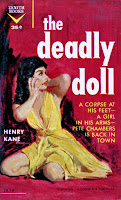
(Left) The Deadly Doll, by Henry Kane (Zenith, 1961).
JKP: And how hard was the culling process, when it came to choosing which examples of Lesser’s artistry could be squeezed into this book and which you had to leave out?
BC: By breaking things up into years, we were able to edit things rather rigorously at the outset. Occasionally, as I said earlier, Ron would find something we would want to add or store for future volumes. It blurs together sometimes, but Bob and I were usually on the same page when it came to what we thought readers would want to see. When layout edits came, I would take Bob’s initial ideas and lay them out, then rework or edit them as necessary in order to enhance the presentation and tell Ron’s story.
JKP: So Bob, you have said that Bill’s design for this book “is particularly fresh for an art book.” Can you be more specific?
RD: Sure. A lot of illustration art books tend to have page after page of full-page reproductions of original paintings or scans of a set of covers on a white background. Often the text is limited to the initial introduction. I told Bill I wanted to intersperse quotes from Ron and other text with images throughout the entire book, similar to what he does on layouts for the
Men’s Adventure Quarterly magazine. I’d been working with Bill on the
MAQ for over a year, and his layouts for those have design elements I said I’d like him to use for the Lesser book. Those elements are things like adding a “texture” to the pages and tinted patterns, so the pages are not simply white; blowups of parts of the artwork; sidebar-style text paragraphs; and other touches that are not common in art books. His designs for
MAQ and other projects he’s done that I’ve seen, reflect Bill’s special vision as a graphic designer who likes to make people say “Wow!” when they see them. They are works of art in themselves, in my opinion, that creatively incorporate art and text elements. Ron told us he really loves the book design, too, which makes us very happy.
JKP: And Bill, what did you try to do with the presentation of this volume that was particularly innovative, satisfying, or a stretch for you to accomplish? What aspect of its design makes you most proud?
BC: Every project is a learning project—or should be. My goal was to figure out the best way to showcase Ron. Period. I especially like that I was able to take scans of Ron’s art and develop some good two-page spreads to focus on his brush strokes. It’s invaluable for the reader’s understanding of illustration. I look at
Isle for a Stranger,
The Third Spectre, and
Horror at Gull House and see the swirl of a brush that creates a stormy landscape, or a dab of a dry brush that renders beautiful hair around a face. The thinking in “layers” I find fascinating,
.jpg)
because I must think the same way in using Photoshop and InDesign in order to put the book together.
(Right) Horror at Gull House, by Patty Brisco (Belmont Tower, 1973).
JKP: You identify this work as “Volume 1.” Can you say yet how many more volumes you plan for the Lesser series, and what specific subject matter those sequels will cover?
BC: We have several planned, but as always, how many more volumes we create depends on how many books we sell. We are a boutique publishing entity. We live and breathe by readers buying our books and, more importantly, telling their friends they bought the books. We do this for the love of books, but we don’t get to do it if it costs us money.
RD: One future volume will focus on Ron’s western, crime, and action/adventure cover art. Another will showcase his post-1979 artwork featuring beautiful women.
BC: Ron has a diverse and extensive archive of art that appeals to different audiences, so there could be more than three volumes in the series. I am ready to design a book that showcases the celebrity portraits and gallery paintings he’s done. I’m also ready to design a book featuring all of the romance art he’s done for Harlequin and other romance publishers. Wherever there’s an eager audience, I want to be able to give them a book they can enjoy.
JKP: Is there going to be a paperback edition of
Deadly Dames and Sexy Sirens released, or are you happy just putting out the hardcover?
BC: Yes, we plan to release a paperback, but it will be a while. Maybe late 2023.
JKP: After celebrating Ron Lesser in this major way, are there other vintage book illustrators whose work you’re hoping to explore with equal depth in the near future?
RD: Well, most of my other favorite artists who did paperback, magazine, and movie art in the ’50s, ’60s, and ’70s are dead, so we couldn’t do projects with them in the quite the same way we have with Lesser. But I do plan to do more books featuring the men’s adventure magazine artwork of Mort Künstler and Gil Cohen. And, although Samson Pollen has passed since Wyatt Doyle and I did two books with him (
Pollen’s Women and
Pollen’s Action), his wife, Jacqueline, has made his art and reference photo archive available to us. We recently tapped that for a third book,
Pollen in Print: 1955-1959, and there’s plenty there for more books.
BC: We both have a lot of projects in the future. I am working with Michael Stradford to bring international adventure comics here to the U.S. in English. I’m also working with award-winning film editor Allan Holzman on the second volume in his
Celluloid Wars film books, and republishing the
Tom Corbett Space Cadet series of YA books. Of course, Bob and I are continuing to deliver
Men’s Adventure Quarterly, and I have ideas to expand our offerings in that arena.




.jpg)


.jpg)