 (Above) Essence of Murder, by Henry Klinger (Permabooks, 1963; back cover here), one of several Klinger novels starring Shomri Shomar, an Israeli police lieutenant on loan to the New York Police Department. (Below, right) The Mourner, by Richard Stark (aka Donald E. Westlake; Permabooks, 1963), the third entry in the series about a career criminal known only as Parker.
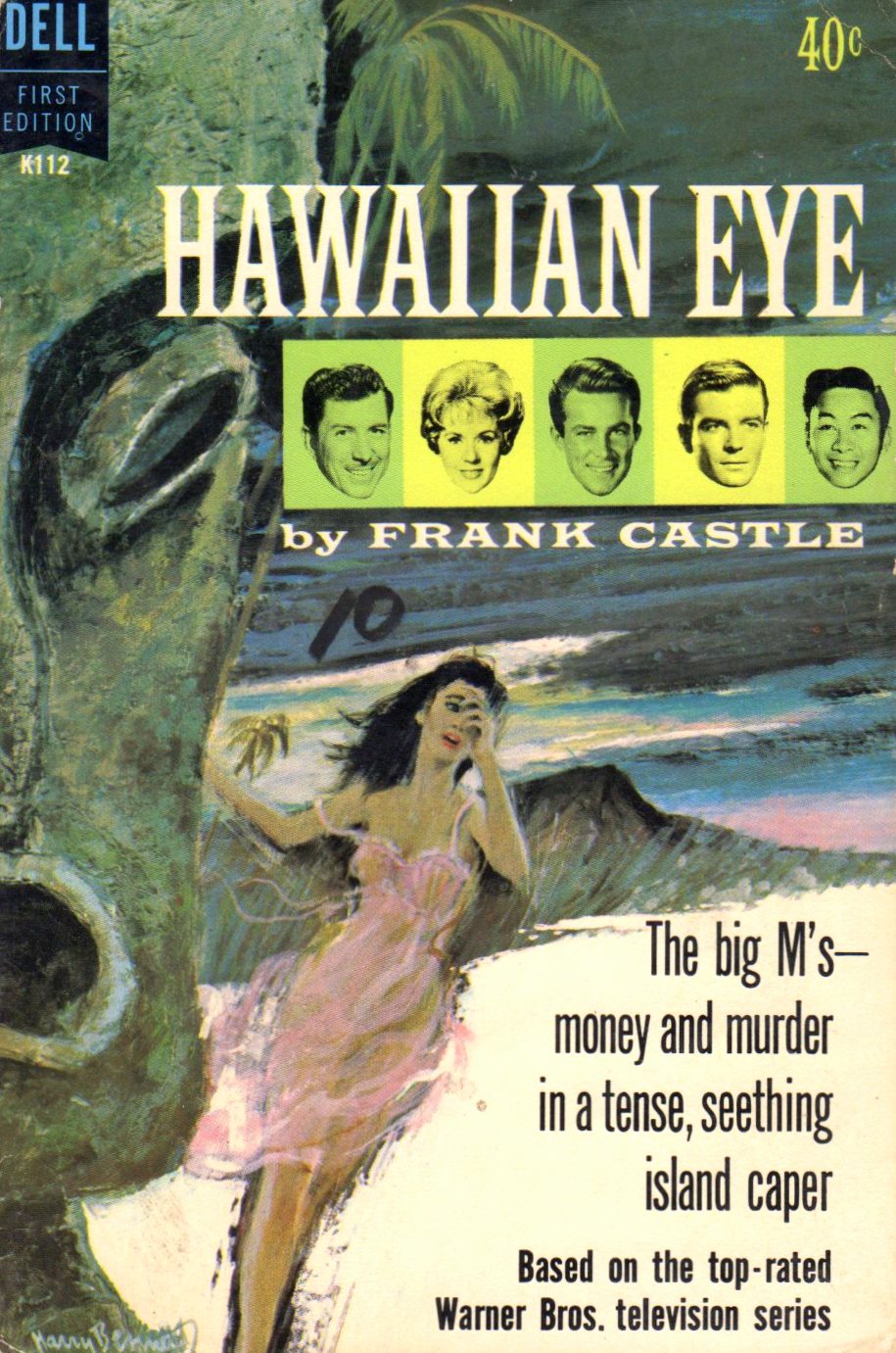
Regular Killer Covers readers know what a fan I have become of artist Harry Bennett’s profuse paperback fronts. His distinctive work has frequently been highlighted on this page—from his illustrations for novels by
Dashiell Hammett,
Frank Kane,
Dolores Hitchens,
Talmage Powell, and
Don Tracy to his contributions to books by
John Brunner,
Agatha Christie,
Noah Clad,
Erle Stanley Gardner,
Thomas B. Dewey, and others. The paintings he produced for U.S. publishers ranging from Permabooks and Pocket to Gold Medal and Berkley could be seductive or shocking, ominous or humorous, but they were rarely less than outstanding. During a more than three decades-long freelance career, Bennett—who passed away just over five years ago, at age 93—created the anterior imagery for everything from detective novels and Gothic romances to Hitchcockian thrillers and tales about amorous young nurses. “Literally millions of people have seen hundreds of paintings by Harry Bennett, but few would know his name,”
writes a blogger who calls himself NatureGeezer and lives in Ridgefield, the historic western Connecticut town where Bennett also resided for most of his life. Along with artists such as Robert McGinnis, Mitchell Hooks, Paul Rader, Harry Schaare, Ernest Chiriacka, and Victor Kalin, Bennett made 20th-century paperbacks worth collecting simply for their covers.
According to his 2012 obituary in
The Ridgefield Press, Harry Raymond Bennett’s long life began on May 15, 1919, in South Salem, New York. “His father,” the newspaper explained, “was a native Ridgefielder whose roots in Ridgefield went back to the 18th century. Bennett was born months after his own father, Harry Bennett, died of the 1918 flu epidemic.” His Swedish-descended mother, Anna Karlsson, is said to have reared Harry and his two sisters, Dorothy and Lillian, “earning income by operating a laundry business.” Bennett graduated from Ridgefield High School in 1937, after first earning acclaim on that institution’s basketball team and being named the president of his class.
He subsequently took a job as a commercial artist with the Magazine Photo Engraving Corporation in Stamford, Connecticut. But in late 1940, as tensions in Europe threatened to boil over, he enlisted in the U.S. Army. Bennett eventually earned the rank of major, and he participated in a 1944 engagement with Japanese forces in the South Pacific that scored him a Bronze Star for heroism.
Following the end of World War II, Bennett—newly wed to a fellow Ridgefielder, Margaret Shean—sought to enhance his creative skills. He attended the venerable
School of the Art Institute of Chicago and the
American Academy of Art in that same Illinois city, and then returned to Connecticut to resume his labors in commercial design, illustrating advertisements for clients on

the order of Buick, Pepsi-Cola, and the Keds shoe company. He lived in a large, historic home (complete with wraparound porch) on Ridgefield’s Main Street, where he also maintained his studio. It was a convenient situation. As the
Press notes, “He would use his family [including his five children] and neighbors as models for over 1,000 book covers and illustrations over the years.”
Bennett took his painting seriously and enjoyed passing his hard-won knowledge on to less-experienced brush-wielders. As his daughter Deborah (also a painter)
recalls, “He was a fine artist of artistic integrity who could tell you the formulas of the old masters, often ground his own paint, and had a lifelong interest in experimenting with different techniques.”
The excellence of Bennett’s artistry, coupled with the energy he brought to his assignments (“Harry had a strong work ethic,” says the
Press obit, “always wanted to be painting or preparing for a painting.”) made him a go-to illustrator for big paperback houses hungry to capture the eyes of busy book buyers. The crime-fiction authors mentioned above benefited from his efforts, but so did best-selling writers such as Mary Stewart, Victoria Holt, Frank G. Slaughter, and Charlotte Armstrong. Bennett’s art won him wide recognition, both in the public arena and among his colleagues. A set of ink paintings he produced “to illustrate a boxed collectors’ edition of Dante’s
Divine Comedy, published in 1966,” resulted in Bennett receiving both a bronze medal from the New York Society of Illustrators and a one-man exhibit at the New York Public Library. (Three of the pieces from that set can be seen
here,
here, and
here.)
But in 1986, with what had once been a significant market for hand-painted paperback-cover illustrations having all but disappeared (as publishers
opted instead for photographic imagery), Bennett decided to retire from the commercial art field and depart New England. He struck out west, painting for himself and doing a bit of teaching, before he and his wife finally settled in Astoria, Oregon, a historic burg at the mouth of the Columbia River. He went on to place his canvases with galleries around Astoria, and it must have been surprising to viewers if and when they discovered that the same dexterous hands responsible for those hanging coastal landscapes and reclining nudes had previously created some of the most memorable book fronts on their home shelves.
Almost two decades after leaving the East Coast, in 2008 the Bennetts moved to Towson, Maryland, near Baltimore, to be closer to their family. Harry Bennett died four years later, on November 29, 2012, from complications of pneumonia.
Bennett may no longer be among us, but the abundant book façades he illustrated certainly are. I claim a small variety of such volumes in my personal library, but scans of a great many more inhabit my computer’s hard drive. With the fifth anniversary of this artist’s demise having passed so recently, I decided to honor his memory with a succession of posts showcasing his work’s diversity. To demonstrate my regard for his talents, I am calling this series “Bennett’s Beauties” (even though that title reminds me of a
less-than-steller Nancy Walker TV series from 1977). It will run on at least through the end of December. Please let me know what you think of the cover selections as their numbers increase day by day.




 the order of Buick, Pepsi-Cola, and the Keds shoe company. He lived in a large, historic home (complete with wraparound porch) on Ridgefield’s Main Street, where he also maintained his studio. It was a convenient situation. As the Press notes, “He would use his family [including his five children] and neighbors as models for over 1,000 book covers and illustrations over the years.”
 Killer Covers is a companion project of The Rap Sheet, a news and features resource for crime-fiction fans, edited by J. Kingston Pierce.





