One in a series of Raymond Chandler novel covers, created by artist Tom Adams and published by Ballantine Books in 1971.
John Dugdale of
The Guardian was good enough to point out that it was 75 years ago today—on
February 6, 1939—that Raymond Chandler’s first private-eye novel,
The Big Sleep, was released by U.S. publisher Alfred A. Knopf. “Reviews in 1939,”
he notes, “were wary and unenthusiastic, however, and only gradually was it
recognised that Chandler had pulled off a bold fusion of highbrow and lowbrow—much-applauded by authors such as W.H. Auden, Graham Greene and Evelyn Waugh, but also much-imitated by fellow chroniclers of murder.”
Other shamuses had trod the fictional mean streets of America, among them Dashiell Hammett’s The Continental Op and Sam Spade, Carroll John Daly’s Race Williams, and more birthed in the rough-paper pages of
Black Mask magazine. But the P.I. genre was new to Great Britain in those World War II years, and Dugdale argues that
The Big Sleep offered even readers in the States “a very different kind of detective” in Los Angeles’
Philip Marlowe.
What was so new? Almost everything in the first chapter, which introduces Philip Marlowe as he visits the Sternwood family mansion. Marlowe speaks to us. Whereas Holmes, Poirot, Maigret, Sam Spade are observed externally, Marlowe is the detective as autobiographer, starting three consecutive sentences in the first paragraph with “I” (ending with “I was calling on four million dollars”).
He is a private detective, yet not patrician. By showing him meeting his social betters, Chandler’s opening contrasts him as a man of the people (like a cop in this, but too nonconformist to be one) with the likes of Holmes and Lord Peter Wimsey, who don’t need the money. Even calling on a potential client—Holmes waits for them to call on him, Poirot has agreeable invitations to country houses—sets him apart.
He is single, and attracted and attractive to women. The opening’s flirtatious encounter with kittenish Carmen Sternwood differentiates him from his predecessors, who tend to be either sexless or married.
He is a dandy, as fond of fine clothes as he is of fine prose: the book’s second sentence mentions his “powder-blue suit” and even describes his socks (“black wool … with dark blue clocks on them”).
He is very literary. His first sentence—“It was about 11 o’clock in the morning, mid October, with the sun not shining  and a look of hard wet rain in the clearness of the foothills”—could be Scott Fitzgerald. In The Big Sleep the initial nexus of crime is … a bookshop.
(Right) The original, 1939 Knopf edition of The Big Sleep.
After three quarters of a century, we’re still admiring Chandler’s graceful and evocative prose, if not always his novel’s plots (which, as in
The Big Sleep, could be a bit ragged). Although some people among us refuse the opportunity to become
Big Sleep fans (case in point
here), the novel spawned what the majority of this genre’s critics would certainly acknowledge is one of the most influential—if not one of the longest (comprising only seven entries)—gumshoe series of the 20th century. More than three decades after Chandler’s death in 1959, another important shaper of the American school of detective fiction,
Robert B. Parker, was interested enough in
The Big Sleep’s story and characters that he penned a
not-altogether satisfying sequel, 1991’s
Perchance to Dream. And it’s hardly surprising to find that Chandler’s 1939 novel remains in print and also remains an instigator of lively discussion in popular literature classes and at crime-fiction conventions.
There have been numerous editions of
The Big Sleep released over the years, some more eye-catching than others. Below are just a few of them. Click on any of the images for an enlargement.


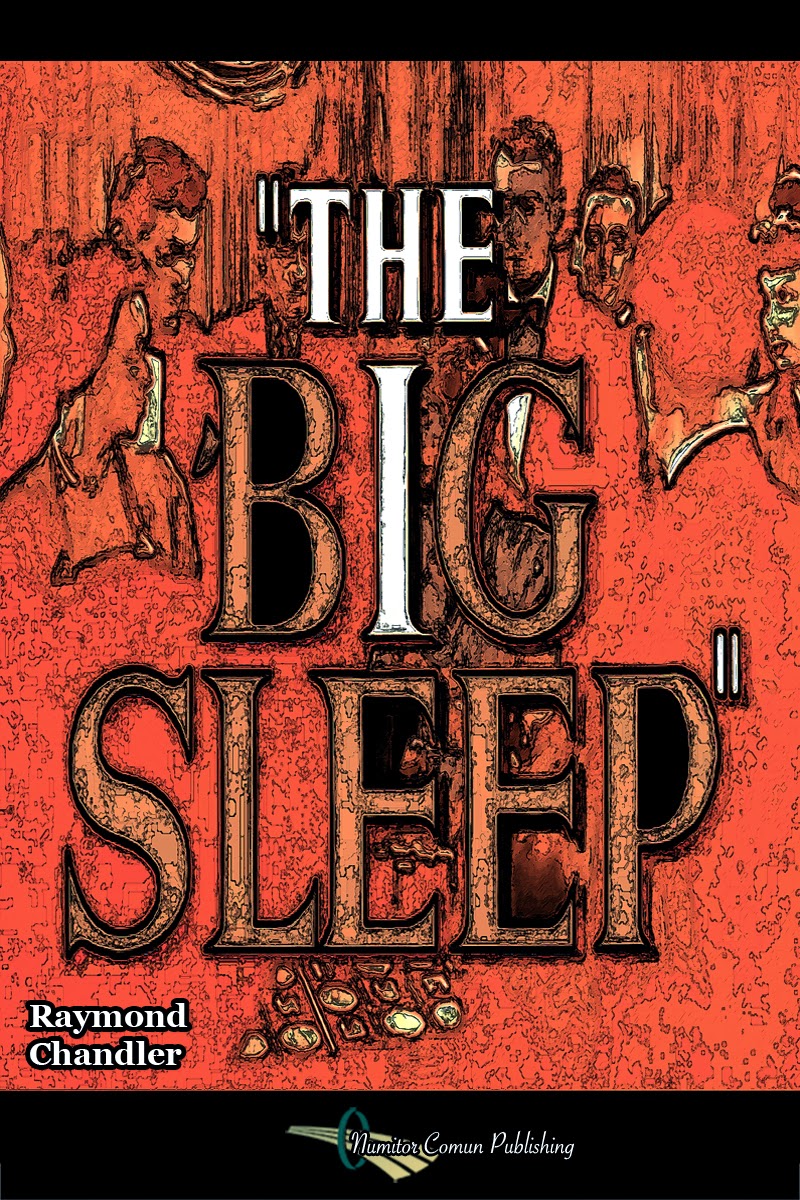

Interestingly, last year, publisher Penguin invited aspiring designers to come up with fresh cover concepts for
The Big Sleep. You can see them all
here, but below I’ve embedded three of my favorites. The first is by
Philippa “Pip” Watkins, the second by Sam Barley. The third cover,
which won the contest, is by Hayley Warnham.
READ MORE: “
Penguin Book Jacket Design” (Speelio Design); “
The Big Sleep, by Raymond Chandler” (The Blog of Hannah Yapp); “
Raymond Chandler Book Covers,” by Eduardo (Illmatic); “
The Art of The Big Sleep,” by Evan Lewis (Davy Crockett’s Almanack of Mystery, Adventure and the Wild West).