Thursday, October 31, 2013

Happy Halloween, Everyone!


“The Lady Is a Witch,” by Norman A. Daniels, in Startling Stories, March 1950. Illustration by Earle K. Bergey.


Witch of the White House, by Jane Hammond (1977).
Illustration by Tony Masero.


The Witch Finder, by Thomas L. O’Brien (1959).
Illustration by Mitchell Hooks.


Water Witch, by Bowie Morton (1962).


The Witch of Spring, by William Shore (1951). Illustration by Ernest Chiriacka, aka “Darcy.”

READ MORE:Carter Brown’s Sexy Witches” (Sexy Witch); “Five Famous Witches in Literature” (The Book Haven).

Wednesday, October 23, 2013

Nude in the Sand, by John Burton Thompson


I’ve been very impressed by the efforts of blogger Robert Deis, aka Subtropic Bob, to catalogue the numerous 20th-century book and magazine covers on which blonde model Eva Lynd appeared. Impressed enough to already have written one piece here, and to now revisit the subject. His latest post on Lynd highlights John Burton Thompson’s Nude in the Sand, which was published by Beacon in 1959 and featured the model in a cover illustration by Al Rossi.

To learn (much) more about Lynd and her remarkable career, check out all of Deis’ posts on the subject in Men’s Pulp Mags.

Tuesday, October 22, 2013

Two-fer Tuesdays: Make Up Your Mind, Already!

A twice-monthly pairing of book covers that just seem to go together. Click on either of these images to open up an enlargement.


Ian Fleming’s Live and Let Die, his second novel starring British secret agent James Bond (after Casino Royale), was originally published in a UK hardcover edition in June 1954. The cover shown above and on left comes from the Permabooks paperback version of that Jamaica-set tale, and was released to bookstores two years later, in 1956. The blog Absolutely James Bond suggests that its illustration--by the prolific James Meese--“may have created controversy at that time as it depicts a white man (Bond) and a white woman ([fortune teller] Solitaire) in chains at the hands of a Black man (Mr. Big).” If so, times certainly have changed, because it seems remarkable nowadays only for the fact that we don’t usually see Fleming’s Agent 007 depicted in such a compromised state.

On the right, meanwhile, we find the front from Live and Let Live, the retitled, 1955 Pocket Books edition of Chesley Wilson’s 1954 novel, Swing Full Circle. There’s apparently no identification of who painted the cover of this paperback (I don’t own this work myself), but the plot description on the book’s rear reads:
From the strong-arm propositions of trigger-happy Commies to the shameless offers of escape-crazy young girls--Tully Sheldon was ready for anything when he took over a World Relief ship on the corrupt China Coast.

Sheldon resisted every bribe--till Alia, the seductive White Russian, led him through Shanghai’s labyrinth of Oriental pleasures.
Or, as the top-front teaser maintains, “She was his--if he could hold her.” If anybody out there has read this novel and knows whether its story lives up to such hype, I’d love to hear about it.

No More Public Reading Statements?

Randal S. Brandt, a librarian at the University of California, Berkeley’s Bancroft Library (and creator of A David Dodge Companion), recently pointed me toward an essay in the blog Design Sponge that talks about the changing impact of covers in the era of e-books.

“Although many a scholar and book enthusiast would be loath to admit it,” writes contributor Maxwell Tielman, “many of the same superficial impulses are at play when purchasing a book as with purchasing things like clothing--impulses like the desire to fit in, stand out, or project one’s personality to the public. This is because, until recently with the proliferation of e-book readers, the book and its cover functioned much in the same way that clothing or furniture did. In a home, printed books would line bookshelves and coffee tables, physical emblems of the owner’s intellectual and artistic tastes and values. Unlike the furniture that fills one’s home, though, books are also portable, making them not only potent symbolic furnishings, but fashion statements.”

Furthermore, the sight of numerous people enjoying the same book in public--on a bus or commuter train, or in a civic square during lunchtime--can make the cover of that work a physical advertisement and influence broad reading habits.

However, with more people reading on tablets and other electronic devices--“identical grey rectangles which bear little or no resemblance to the content held within”--the covers of books have become less important. “Although it might be too early to say whether or not the e-book industry will have a detrimental impact on ‘high’ literature and our general appreciation for book design, it will be interesting to see how this trend progresses,” Tielman concludes.

You can find his complete essay here.

READ MORE:25 Reasons Real Books Are Here to Stay,” by Kelly Robinson (Book Dirt).

Tuesday, October 8, 2013

Two-fer Tuesdays: That First Step’s a Doozy!

A twice-monthly pairing of book covers that just seem to go together. Click on either of these images to open up an enlargement.


“Robert Standish,” author of the 1960 Four Square paperback on the left, The Big One Got Away, was a pseudonym often used by Englishman Digby George Gerahty (1898-1981), who wrote some three dozen novels, in addition to numerous short stories. Among his books was the Ceylon-set Elephant Walk (1948), which was filmed in 1954 with Elizabeth Taylor, Dana Andrews, and Peter Finch. The cover shown here features an illustration by Roy Carnon, another Brit, who worked primarily in advertising, but also painted fronts for some of Edgar Rice Burroughs’ science-fiction novels and created concept illustrations for the 1968 movie 2001: A Space Odyssey.

On the right is shown Deadly Night Call, the 1951 Graphic Books paperback edition of Cornell Woolrich’s 1950 short-story collection, Somebody on the Phone, which he published under his nom de plume William Irish. The title of that book comes from a story about blackmail, suicide, and revenge. I don’t find mentioned anywhere on the Web the identity of the artist responsible for this paperback’s shocking cover, but the site Vintage Paperback Archive mentions that “Graphic Books only existed from 1949 till 1957. During that time they focused on mysteries and hard-boiled detective.”

READ MORE:Cornell Woolrich’s Mysterious Tales of Sorrow & Horror,” by Jessica Amanda Salmonson (The Weird Review); “Falling Bodies” (Pulp International).

Monday, October 7, 2013

Dying to Go Surfing

As I’ve often tried to explain to my friends (with limited results), sometimes paperback crime novels are worth buying simply for their fabulous covers. I have boxes of aged paperbacks that I’m planning to read someday, but in the meantime, I pull them out every once in a while just to revel in their beautiful or offbeat fronts.

Among those still not in my collection are the Operation Hang Ten novels, a paperback series--published by MacFadden-Bartell from 1969 through 1973--that featured skilled surfer and world-traveling CIA agent Bill Cartwright, and was penned by “Patrick Morgan” (in actuality, the prolific George Snyder). No matter how diligently I have hunted through used bookstores in my travels, I have yet to turn up even one of these titles. (Yeah, I know: I could probably order them online, but that would obviously take away from the thrill of the chase.) I’m particularly interested in snagging Freaked Out Strangler (1973) and The Girl in the Telltale Bikini (1971).

You can take appreciate the Hang Ten covers for yourself here.

In Space, No One Can Hear You Dream

This collection of fronts from paperback novels based on modern science-fiction films is so fun, I’m sorry that the books don’t actually exist. I am especially fond of the Blade Runner front. Sean Young’s replicant, Rachael, never looked so good!

There are a couple more Star Wars examples here.

Tuesday, October 1, 2013

Remembering a “Master Storyteller”


Earlier today, my retrospective piece about the life and abundant output of Scotland-born adventure-thriller writer Alistair MacLean was posted on the Kirkus Reviews Web site. That full column is here.

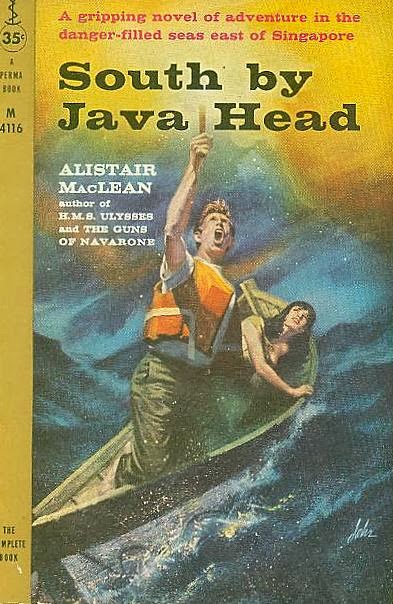
In the course of researching MacLean’s history, I collected an extensive variety of cover images from his 28 novels, which were published between 1955 (HMS Ulysses) and 1986 (Santorini). Rather than let those go unused, I have created a gallery of the various books fronts below. These are certainly not all of the covers I found--but they are, perhaps, the most interesting. Included here are dust jackets from first editions of MacLean’s fiction, which I found on the AlistairMacLean.com site. (Terry Zobeck pulled those images together, and he’s given me permission to reuse them here. “Anything to help spread the word on MacLean,” he told me in an e-note.) The other images I discovered over many hours of searching the Internet. Steve Holland’s Bear Alley blog offered a particularly rich trove of MacLean fronts.

You’re invited to give your opinions about these covers in the Comments section at the end of this post.

And click here to participate in The Rap Sheet’s poll asking readers to name their favorite works among MacLean’s classic oeuvre. If you have not already made your voice heard in this survey, you have until the beginning of November to do so.

Click on any of the images below for an enlargement.


READ MORE:Alistair MacLean Spin-offs Cover Gallery,” by Steve Holland (Bear Alley).