Showing posts sorted by relevance for query whittington. Sort by date Show all posts

Sunday, May 24, 2009

Strange Bargain, by Harry Whittington


I’ve been sitting on this fantastic 1959 cover from Harry Whittington’s Strange Bargain for several months now, trying to figure out who was responsible for the jacket illustration. But I’ve had no luck thus far. If it was necessary to hazard a guess, I’d say it was the dramatically executed work of prolific paperback artist Robert Maguire (some of whose work can be seen here). But it might instead have been executed by artist Barye Phillips, who was much in demand by soft-cover publishers back in the 1950s and ’60s, and who created fronts for several other Whittington works (including Saturday Night Town and Desire in the Dust). Then again, the Strange Bargain jacket could have been created by James Meese, whose front for M.E. Chaber’s A Hearse of Another Color was featured on this page just a few weeks ago. The problem, of course, is that there’s no credit given in the book for this cover art. Paperback publishers of that era didn’t necessarily foresee a day when their products would be collector’s items, so they weren’t conscientious about making sure that credit was given where it was due.

That’s certainly too bad in this instance.

For readers unfamiliar with Harry Whittington’s work, you should know, first, that this is not the same Whittington who Dick Cheney filled full of birdshot during a hunting incident three years ago. No, author Harry Benjamin Whittington was born in the north Florida town of Ocala in 1915, served with the U.S. Navy during the Second World War, married in 1936, and put in stints as a copywriter and editor before “retiring to write full-time in 1975.” According to a biographical note at the Web site of publisher Stark House Press, which has brought several of Whittington’s novels back into print over the last several years, as a boy the author “survived his family’s rural poverty by reading books and sneaking into the local movie theater. Another escape was his writing. Ultimately, the versatile Whittington would become known as ‘King of the Paperbacks,’ publishing over 170 original paperback novels, using nearly 20 different names.” Under those noms de plume, he published hard-boiled crime novels, more formulaic mysteries, westerns, and soft-core porn novels. “Before his death in 1989,” Stark House adds, “Whittington also carved out a second career writing Southern historical novels as Ashley Carter. Today he is best known for the lurid and brisk noir novels he wrote between 1950 and 1960.”

Novelist Ed Gorman wrote in Mystery*File a few years ago that
Back in the 1950s you could run but you couldn’t hide from Harry Whittington. Those were the days when many if not most paperbacks were sold in wire racks found in drug stores, grocery stores and what were then called dime stores.

Harry told me that he’d once seen five books of his displayed on the same rack, all published that month. He worked for everybody, from Gold Medal all the way down to Carnival. He did westerns, nurse romances, tie-ins, war stories and of course crime novels. The last was his true calling. There ... was no sub-genre of suspense/mystery he didn’t like. Or apply
himself to.
Today, Whittington’s work is largely forgotten, and mostly long out of print. But Texas author Bill Crider, who includes Whittington among his favorite paperback novelists (and has assembled a remarkable collection of that author’s book covers at Flickr), cites 1960’s A Night for Screaming as a work well worth discovering. “One thing Whittington can do about as well as anybody ever could,” Crider opined in a blog post about Screaming, “is begin the book with a tense situation and then dial up the tension on every succeeding page. He can put his protagonist into a situation that seems as bad as it can get, and then he can make it worse. And after that, he can make it worse still. In this book he takes a seemingly simple situation and complicates it more with every chapter, throwing in a few reversals and surprises along the way. If you ever run across a copy of A Night for Screaming, don’t pass it up. You’ll be sorry if you do.” (Fortunately, Stark House Press reissued A Night for Screaming--along with another of Whittington’s 1960 works, Any Woman He Wanted--in a combined trade paperback edition three years ago.)

When asked about Strange Bargain, Crider admits he “read the book so long ago that I can’t remember much about it.” However, the Avon Books cover--with its image of a man and a trenchcoated blonde caught in seemingly intimate contact, and not pleased at all by the interruption (that’s my surmise, anyway, judging by the fact that the man is reaching for a gun on the floor)--supplies the tale’s gist: “The suspenseful story of a woman’s terrible choice between the two men who claimed her!” And the back jacket copy offers more:
TWO MEN AND ONE WOMAN--in a stark tale of love and hate:

THE HUSBAND, who faced death, yet thought only of a plan to destroy his rival.

THE WIFE, who could save her husband only by bargaining with a man who had but one desire--a woman.

THE LOVER, who knew love only as a wild, fierce hunger too long denied him.

On a barren, windswept mountain, these three are caught in a timeless drama that must end in shattering violence.
That’s the sort of teaser that would get you to read Strange Bargain, no matter who illustrated its jacket.

THE SINCEREST FORM OF FLATTERY: Apparently, British publisher Panther thought enough of the Strange Bargain cover, that in 1962 it “borrowed” its artwork for the front of Peter Rabe’s Anatomy of a Killer, an entry in its Crime Circle paperback line. You will find the front and back of Rabe’s novel here.

READ MORE: “The Paperback Covers of Harry Whittington,” by Bill Crider (Bill Crider’s Pop Culture Magazine).

Sunday, November 30, 2025

“Army Girl,” by Whit Harrison


Army Girl, by “Whit Harrison,” aka Harry Whittington (Paperback Library, 1962). The Florida-born Whittington (1915-1989) was a prolific author of both crime fiction and western fiction, who wrote under a variety of pseudonyms. A few of his books have been brought back into print by Stark House Press, but not yet Army Girl.
Cover artwork by Harry Schaare. His original artwork for this softcover novel can be enjoyed below. An earlier edition of Army Girl, published by Venus Books (and with a front illustration by Rudolph Belarki) can be seen here.

Monday, March 23, 2020

Hooks Hits: “Brute in Brass”

Part of a series saluting artist-illustrator Mitchell Hooks.


Brute in Brass, by Harry Whittington (Gold Medal, 1956).

Tuesday, July 1, 2014

Two-fer Tuesdays: Kick Up Those Heels!

A twice-monthly pairing of book covers that just seem to go together. Click on either of these images to open up an enlargement.


“If you ever run across a copy of A Night for Screaming, don’t pass it up,” Texas novelist Bill Crider wrote in his blog several years back. “You’ll be sorry if you do. It’s a dandy story, and it has a great cover, besides.” Having not yet read this book by the prolific Harry Whittington, the oft-heralded “King of the Paperbacks,” I can’t attest to its exceptionalness as a work of fiction, but I certainly agree that the 1960 Ace Books edition boasts an exquisite front. It shows a blonde in red, fleeing across an open field at night with a gun in one hand, pursued by a speeding car, its headlights separating her from the darkness. Any moment, it seems likely that the vehicle will overtake her--with predictably messy results.

The blog Battered, Tattered, Yellowed & Creased describes the plot of this book (which can be purchased in a newer edition from Stark House Press) as follows:
Mitch Walker is on the run for a crime he didn’t commit. As a rookie cop, the last thing he wants is for his partner to beat a confession out of him, so he’s fled to the farmlands of Kansas in hopes of escape. Broke, down on his luck, and with the local police after him for panhandling, Mitch takes a chance and signs on to a local farm as a laborer--a sprawling farmstead that’s half volunteer, half county prison. The farm owner is a rather intense nutjob, his wife is a loose woman, the foreman is oblivious to the racketeering run by the abusive straw-bosses. And stuck right in the middle is Mitch, with his old partner still on his trail …
Responsibility for the Ace cover art has been left ambiguous by online sources, most of which say it is simply “uncredited.” I dropped an e-mail note to Crider, asking him whether the illustrator is identified on the outside or inside of the copy in his possession, and he sent this reply: “I’ve looked at the cover with a magnifying glass, and unless the artist’s name is well-concealed in the grass, it’s just not there. There’s no credit given anywhere in the book, either.”

However, a subsequent bit of detective work by Crider turned up this Web page naming Robert Maguire as the person behind A Night for Screaming’s façade. Furthermore, the official R.A. Maguire Cover Art gallery maintained online by his daughter, Lynn, includes that paperback front among its offerings. It’s odd that this cover doesn’t also appear in Jim Silke’s fine 2009 work, Dames, Dolls, and Gun Molls: The Art of Robert A. Maguire. But at least until further evidence is brought forward, we can defend our presumption that Maguire was the painter. It does seem to display his talent.

Significantly less in question is Harry Bennett’s credit for having created the front for the 1963 Gold Medal paperback edition of Alone at Night, by Vin Packer (aka Marijane Meaker). Again, I’ve not read this book, but U.S. publisher Prologue--which reissued the novel in paperback last year--characterizes its storyline this way:
On their first night Carrie had been nervous, and Slater had tried to think of some way to make it easier for her, to show her how fine and free it could be. But the moment they'd stepped into the cabin, she had undressed, matter-of-factly, a cigarette dangling from her lips. Her body was white and incredibly lovely, and Slater had felt desire engulf him. He had held her, hungrily, and hardly listed to the one thing she’d said. “I don't think I’ll be much good at this.” She had been so cruelly right. And that, in a way, was what had killed her. That, and a beautiful woman named Jenny.
From that description, there’s no telling how the scene of a dark-haired lovely fleeing anxiously into the night, only steps ahead of two more automobile headlights--the episode depicted so powerfully on this novel’s front--fits in. But maybe there’s a clue in Alone’s cover teaser line: “Slate and Jenny, who broke all the commandments, learned the last one the hard way: Thou shalt not look behind thee.” Certainly when running for your life, you do not want to waste time glancing back to see how closely death follows on your heels. Just thinking about the imminent violence suggested by both of these book fronts is enough to give one nightmares.

Tuesday, September 24, 2013

Two-fer Tuesdays: So What’s the Rush, Already?

A twice-monthly pairing of book covers that just seem to go together. Click on either of these images to open up an enlargement.


Featured here on the left is the front from Hell Is My Destination, by John Conway (a pseudonym used by Pennsylvania-born journalist-turned-author Joseph Chadwick). According to a post in Andrew Nette’s Pulp Curry, this edition was “published in Australia by Starbooks, Crow’s Nest Sydney, and published by Griffin Press in South Australia.” Apparently, there’s no publication date in the novel, but Nette’s best guess is that it came out in the late 1960s. (Another version of this same tale--with a very different cover--was released in the States by Monarch Books in 1959.)

Meanwhile, on the right you see the front from the 1960 Gold Medal edition of Hell Can Wait, by the prolific Harry Whittington. Unfortunately, I don’t find information on the Web about who illustrated these two paperback covers. If anyone in the Killer Covers audience can provide artist credits, I hope they’ll drop them into the Comments section of this post.

Tuesday, October 28, 2014

Cover Affairs

Later today, in The Rap Sheet, I shall post the larger part of an e-mail interview I did recently with Art Scott, who wrote the text for the beautiful new book, The Art of Robert E. McGinnis (Titan). During the course of our exchange, I asked him to identify his 10 favorite paperback covers by artist-illustrator McGinnis. He sent me 12, instead, beginning with one he says “has to be on everybody’s list!”

Brooks Wilson Ltd., by J.M. Ryan (Gold Medal, 1966). McGinnis’ full, fabulous wrap-around artwork is featured here.


Slab Happy, by Richard S. Prather (Fawcett Gold Medal, 1973); Bats Fly at Dusk, by Erle Stanley Gardner (1960).


Judith, by Brian Cleeve (Berkley, 1979); Oh Careless Love, by Maurice Zolotow (Avon, 1959).


The Savage Salome, by Carter Brown (Signet, 1961); Letters from Philippa, by Anne Graham Estern (Bantam Skylark, 1991).


On the Run, by John D. MacDonald (Fawcett, 1963); The Case of the Reluctant Model, by Erle Stanley Gardner (Pocket 1963).


Don’t Speak to Strange Girls, by Harry Whittington (Gold Medal, 1963); Blood on Biscayne Bay, by Brett Halliday (Dell, 1960); below -- Backwoods Teaser, by Gil Brewer (Fawcett, 1960).

Monday, December 31, 2018

The Twelve Dames of Christmas, 2018: #7

Celebrating this festive season with brassy bombshells.


Designing Dame, by J.X. Williams (Greenleaf Classics/Idle Hour, 1966). As Those Sexy Vintage Sleaze Books explains, “J.X. Williams was the original pen name for John Jakes [see more here], and then later used as a house name by many, from Harry Whittington to George Smith and David Case. And editor Earl Kemp … Kemp, when not running the Cornith/Greenleaf imprints, wrote a few titles himself …” Illustration by Darrel Millsap.

Tuesday, June 17, 2014

Two-fer Tuesdays: Their Aim Is True

A twice-monthly pairing of book covers that just seem to go together. Click on either of these images to open up an enlargement.


This week’s combination is dedicated to all those people who sometimes feel besieged by bosses, spouses, or louses of one variety or another. Being marked for attack is no picnic whatsoever, as the characters in these two novels can well attest.

On the left we find the 1959 Pocket Books edition of The Moving Target, the first novel to feature Los Angeles private eye Lew Archer, written by “John Macdonald” (actually, Kenneth Millar, who would soon change his nom de plume to Ross Macdonald). The man behind that paperback’s glowing imagery was Jerry Allison, who has also been credited with illustrating this book, as well as this one.

Now look to the right, and you’ll find the cover of The Hired Target, by Wilson Tucker. It was released in 1957 as by Ace Books as a “Double Edition” paperback, combined with Harry Whittington’s One Deadly Dawn. The prolific Lou Marchetti was responsible for creating this book’s striking cover art, which fulfills the challenging assignment of being both tender and threatening.

Friday, July 31, 2026

Slice of P.I.: “Shady Lady”

(Part of a series celebrating fictional private eyes.)


Shady Lady, by Cleve F. Adams (Ace, 1955). Originally published as Too Fair to Die, one of two works paired in a cheap, 1951 Two Complete Detective Books edition with Fredric Brown’s Compliments of a Fiend, Shady Lady was expanded, retitled, and repackaged as an Ace Double Novel opposite Harry Whittington’s One Got Away. It marked the sixth and final outing for Adams’ Rex McBride, a controversial Los Angeles dick described by one critic as “a racist, a fascist, and a hypocrite, but a tender ballad brings tears to his eyes. In one word, he’s an oaf, deliberately drawn by Adams so as to pull the rug out from under [Raymond] Chandler’s romantic image of the P.I. as a contemporary knight.” Cover artwork by Harry Barton.

Thursday, January 19, 2023

We’re 14 Today. Wanna Make Something of It?


(Above) Rebels in the Streets, by Kitty Hanson (Midwood Tower, 1965); art by Mitchell Hooks. As one commenter on Flickr wrote of this cover, “Nothing says ‘evil’ like capri pants and ballet flats.”


Every January, in anticipation of yet another birthday for Killer Covers, I try to come up with some appropriate way to celebrate. Last year, for instance, when the blog turned 13—a number with a very bad reputation—I decided the most fun thing to do was showcase vintage crime novels with the words “luck” or “lucky” in their titles.

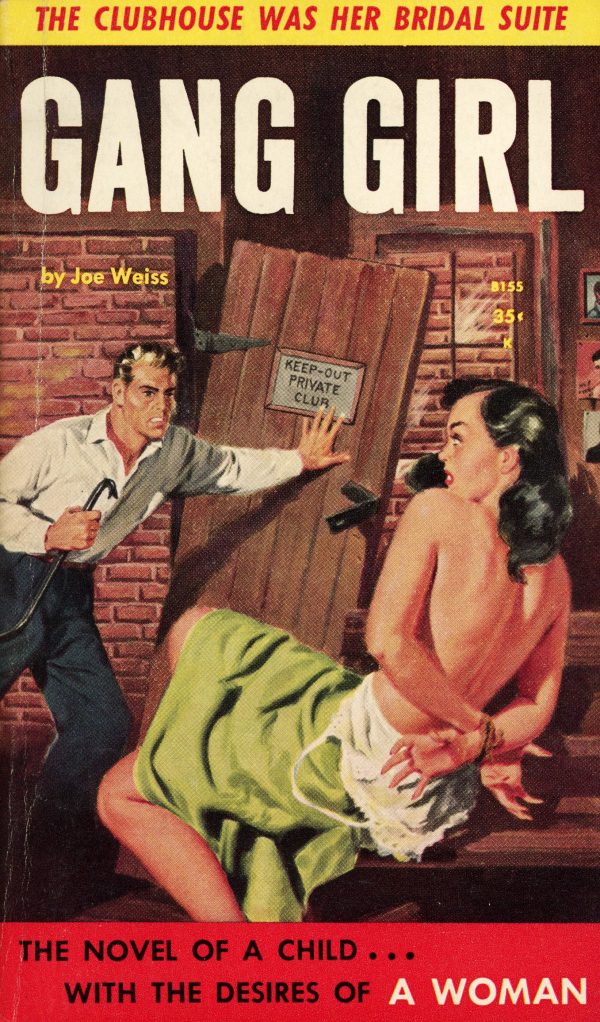
This year was a bit more challenging. While looking around for things synonymous with the numeral 14, I discovered the following on an online information source called The Fact Site: “The number 14 is, unfortunately, associated with white supremacy. This is because one of the more popular white-power slogans, ‘We must secure the existence of our people and a future for white children,’ has fourteen words. While known as the ‘14 Words,’ it is commonly shortened to just ‘14.’” The very last thing I want to do is validate hateful racist ideas, so spinning a post off from that connection to the number was a non-starter. Instead, I mused on various ways young people were portrayed during the American heyday of paperbacks. And I realized that they were too often shown negatively. During the mid-20th century, authors and book artists were prone to define teenagers as aborning gangsters, arrant delinquents, drug addicts, experimenters with wild sex, trouble-bound runaways, youths neglected by their parents and left—as the cover text on a 1958 book titled Bad Girls reads—to “prowl the fringe of the underworld for kicks.”

(Right) Bad Girls, by Leo Margulies (Crest, 1958).

Amid such alarming propaganda (no doubt circulated in part simply to goose book sales), it’s a wonder that children of the era—especially those who claimed residence in large cities, where lawbreaking was well-recorded—were allowed to stray beyond sight of their homes. Not that adults could prevent them from leaving and making mistakes. As The Fact Site also informs me, “In the U.S., the youngest age at which you can be legally emancipated from your parents or guardians is 14. Known as the emancipation of minors, it essentially frees a child of fourteen or older from control by their legal guardians and freeing the guardians of any responsibility towards the minor.”

For better or worse.

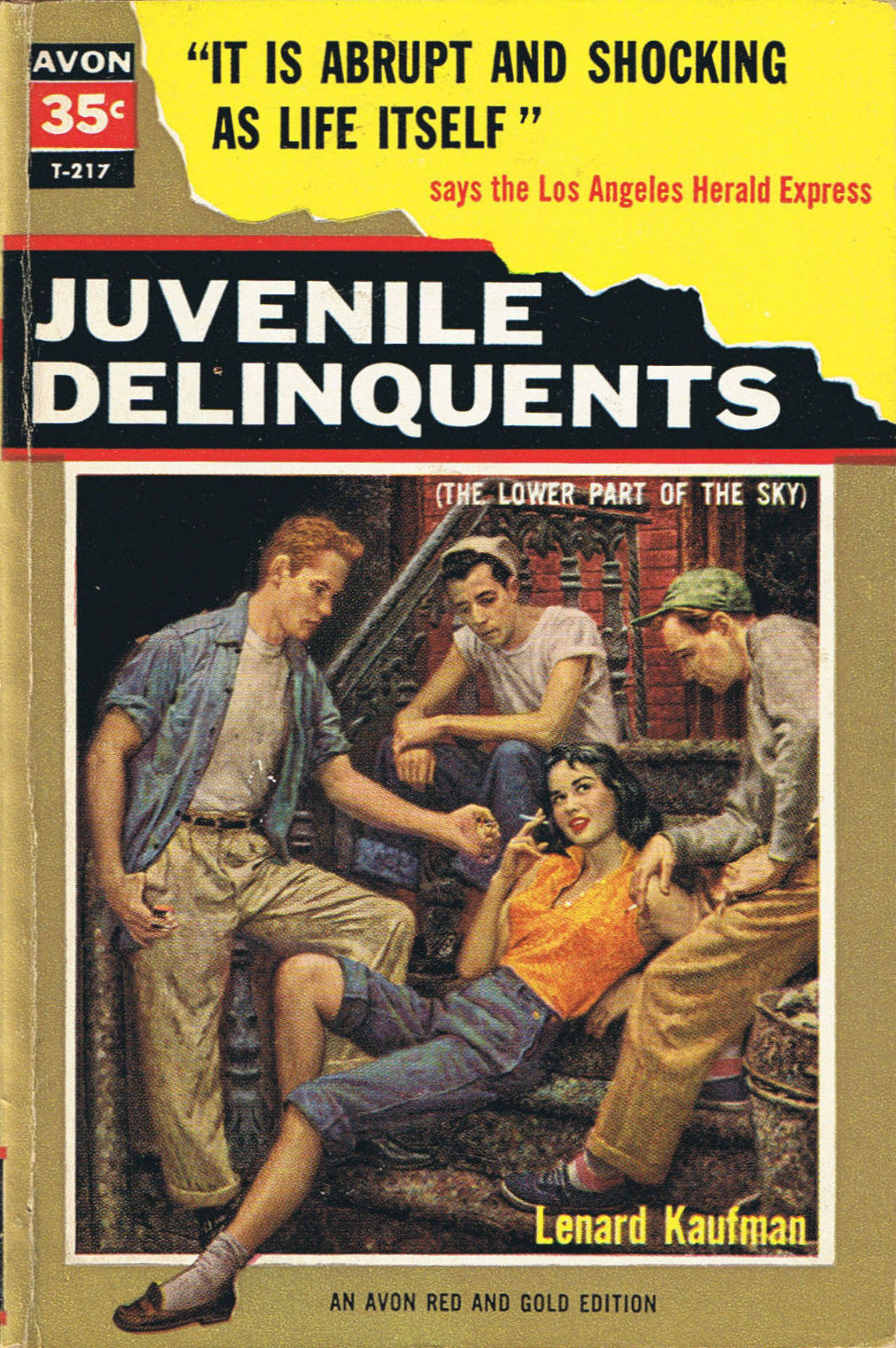
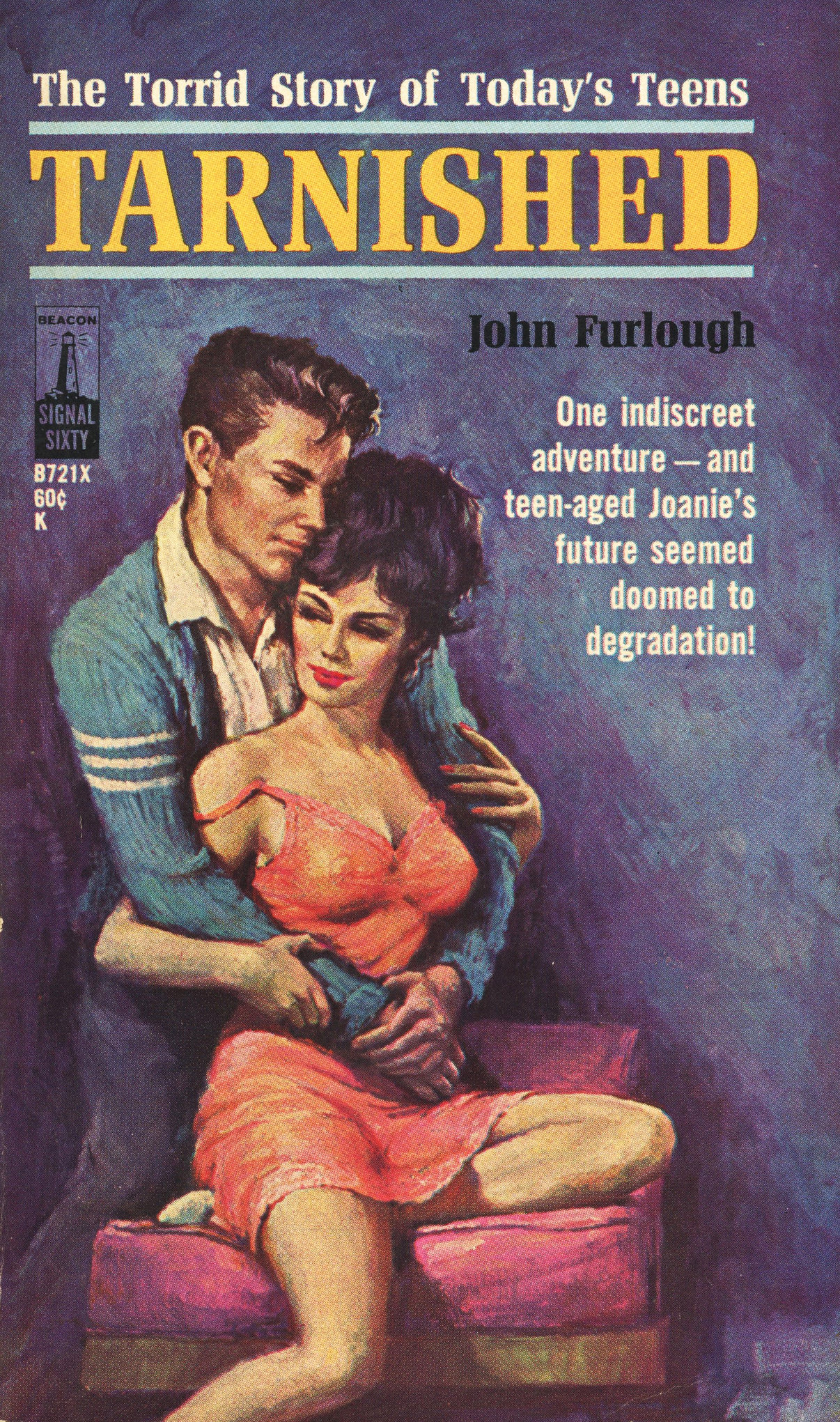
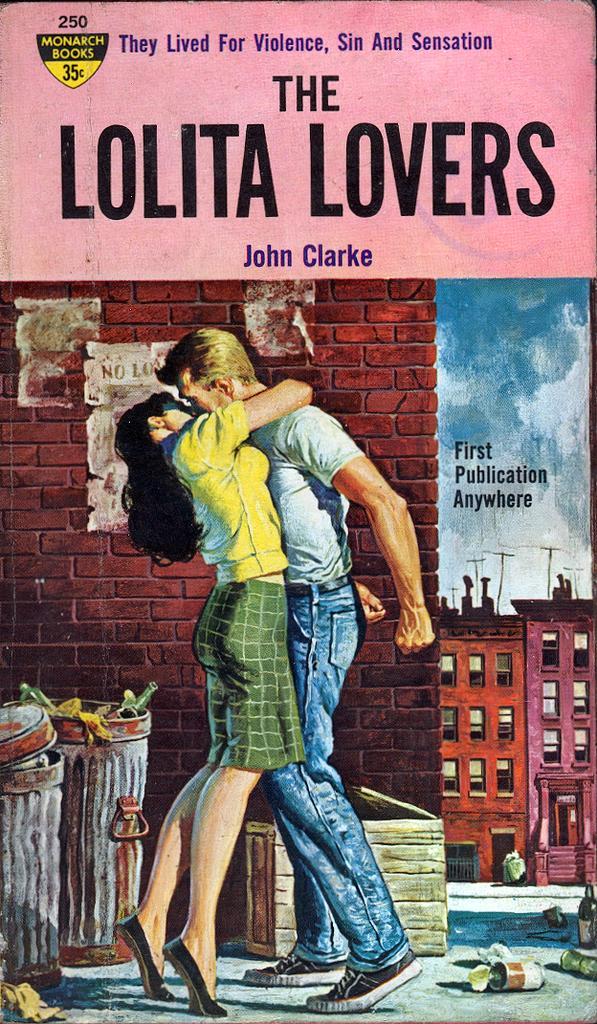
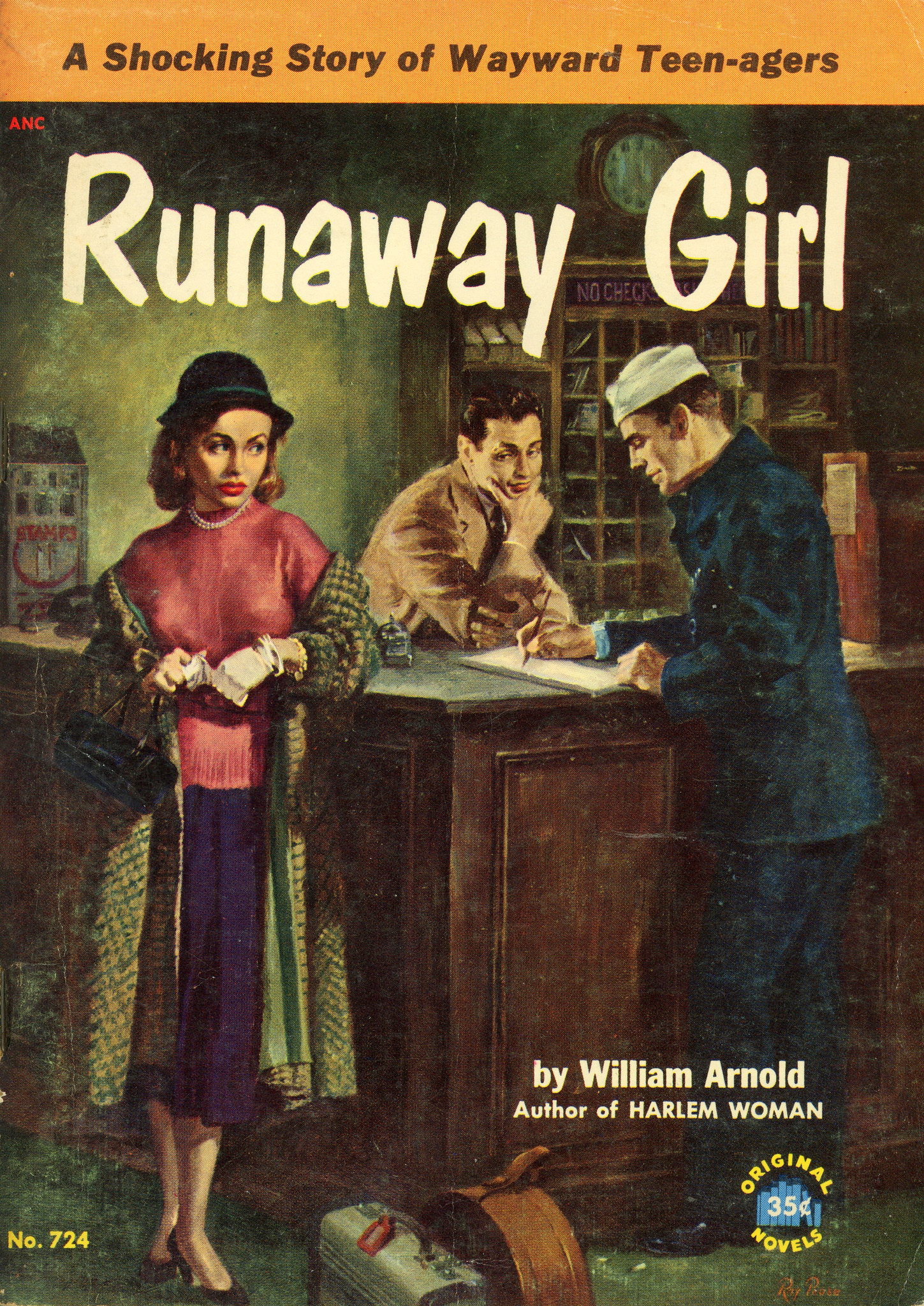
It happens that my computer files contain a wide variety of vintage paperbacks focused on delinquents and other teenagers gone wrong, which I’ve picked up over the years. Since today’s 14th Killer Covers birthday finds me in a feisty mood anyway, I’ve decided to commemorate the occasion with 50-odd examples of that genre, displaying parents’ worst nightmares of what their children (not all of whom are 14) could get up to if left unsupervised for long.

Within this gallery you’ll find multiple novels named Gang Girl(s), several with the ominous word “jailbait” in their titles, and others suggesting that “cool” and “criminal” are altogether synonymous. The most represented author is probably Wenzell Brown, but there are works, too, by Vin Packer (aka the recently deceased Marijane Meaker), Harlan Ellison (who once joined a Brooklyn street gang for research purposes), Harry Whittington and Whit Harrison (one and the same writer), Orrie Hitt, Hal Ellson, Joan Ellis (one of several pen names employed by the prolific Julie Ellis), Evan Hunter, Henry Gregor Felsen, and screenwriter Irving Shulman.

Click on any of the images below for an enlargement.


Unfortunately, I haven’t found credits for all of these paperback fronts. But among the artists whose work is included here are James Meese (Bad Girls, Teen-age Terror, The Young and Violent, Cry Kill), Robert Maguire (Jailbait Jungle, Tomboy), Tom Miller (The Gang Girls), Ernest “Darcy” Chiriacka (Digit’s Hate Alley, Cry Tough!), Raymond Johnson (1952’s Juvenile Delinquents, Jailbait Street, I’ll Fix You, and Cry, Brother, Cry), Samson Pollen (D for Delinquent, Ace’s Hate Alley), Paul Rader (1964’s Gang Girl), Barye Phillips (Teen-age Mafia, The Beat Generation, Strike Heaven on the Face), Mitchell Hooks (End of a J.D., Rag Top), Rudolph Belarski (Jailbait, Rapture Alley), George Ziel (The Little Caesars), Rafael DeSoto (Teen-age Gangs, The Lolita Lovers), Clark Hulings (The Blackboard Jungle), Robert Schulz (Hell to Pay), Gilbert A. Fullington (1954’s Gang Girl), Lou Marchetti (The Long Night), Victor Kalin (Young and Wild), Robert Bonfils (The Delinquents), and Raymond Pease (Runaway Girl).

If you’re interested in finding additional juvenile delinquent-related covers, check out a pair of previous Killer Covers posts, the first focused on James Bama’s contributions to this breed, the second showcasing the myriad risks young people might face by going to school. Or go to the blog Pulp Covers, where I found many of the images shown above, and which has still more to admire.