Showing posts with label Videos. Show all posts

Sunday, January 19, 2025

We Are Sixteen Going on Seventeen


I absolutely love the paperback artistry of Ernest Chiriacka, aka “Darcy” (1913-2010), so I’ll employ pretty much any excuse to post more of his work on this page. But today is a special occasion—Killer Covers’ 16th birthday! To celebrate that, I am finally displaying (above) his front from the 1960 Pyramid Books edition of Roadside Night, by Erwin N. Nistler and Gerry P. Broderick.

Alas and alack, this is not a novel from my collection. But I’ve heard favorable comments about it over the years. The excellent blog Reading California Fiction—which was written by Don Napoli, before his death at age 79 in early 2021—offers this synopsis of its plot:
Ex-Marine Buck Randall is settled into a comfortable life. He owns and manages a small bar and motel up the coast from San Diego. The business keeps him solvent. His assistant Dom reliably helps out around the place. Joyce, an attractive eighteen-year-old who’s had a crush on him for years, is eager to become a serious girlfriend. His steady customers are also his friends. Then one day a stunning redhead, Sylvia Landon, comes into the bar. She exudes a sex appeal that Buck hasn’t felt before. Even after she leaves he can’t stop thinking about her. She returns; they talk briefly. She returns again; he cooks dinner for her. They spend the night together. He’s hooked.

The general outline of this story is apparent from the first few sentences. Sylvia is going to lure Buck into trouble to fulfill some nefarious purpose of her own. That’s not an original premise. So the question is how effectively Nistler and Broderick work it out. And here the authors deserve kudos all around. Buck, the first-person narrator, not only describes events but relays his feelings as well. These change with each plot twist. Longing, satisfaction, doubt, curiosity, guilt, anxiety all run through his mind. The writing is spare almost (but not quite) to the point of parody: short words, short sentences, short paragraphs, and of course a short book. The terseness keeps the story moving quickly and generates tension until the very end. Fans of the
femme fatale are bound to enjoy this book.
The pair behind that slender example of “motel noir” are hardly household names. Novelist James Reasoner wrote in a 2009 critique of Roadside Night that “As far as I’ve been able to discover, this is the only book [Nistler and Broderick] ever published.” Nonetheless, he agrees with Napoli that it’s a better-than-average crime yarn. “What makes it worth reading is the prose,” Reasoner opines, “which is bleak and fast-paced, and the sweaty air of doom and desperation that hangs over the book like fog rolling in from the sea. … This isn’t some lost masterpiece of crime fiction, but it’s well worth reading and would make a good candidate for reprinting.”


There have already been several editions of Roadside Night produced, all by Pyramid. The one presented just above and on the left is the original printing from 1951, boasting an illustration by Canada-born Hunter Barker. To its right sits a still more captivating version, released in 1955. I regret not knowing the identity of that one’s cover artist. Does anybody reading this recognize the style?

When I launched this blog in 2009, I never imagined I’d still be writing it more than a decade and a half later. Yet here we are. I have a multitude of covers just as interesting as these stored away in my computer files. All I need is the energy, free time, and—in cases such as this—the proper occasion to retrieve and post them. Thank you for sticking with me during this long and oft-surprising ride!

(And yes, a classic song inspired the title of this piece.)

Wednesday, November 1, 2023

A Treasury of Templars

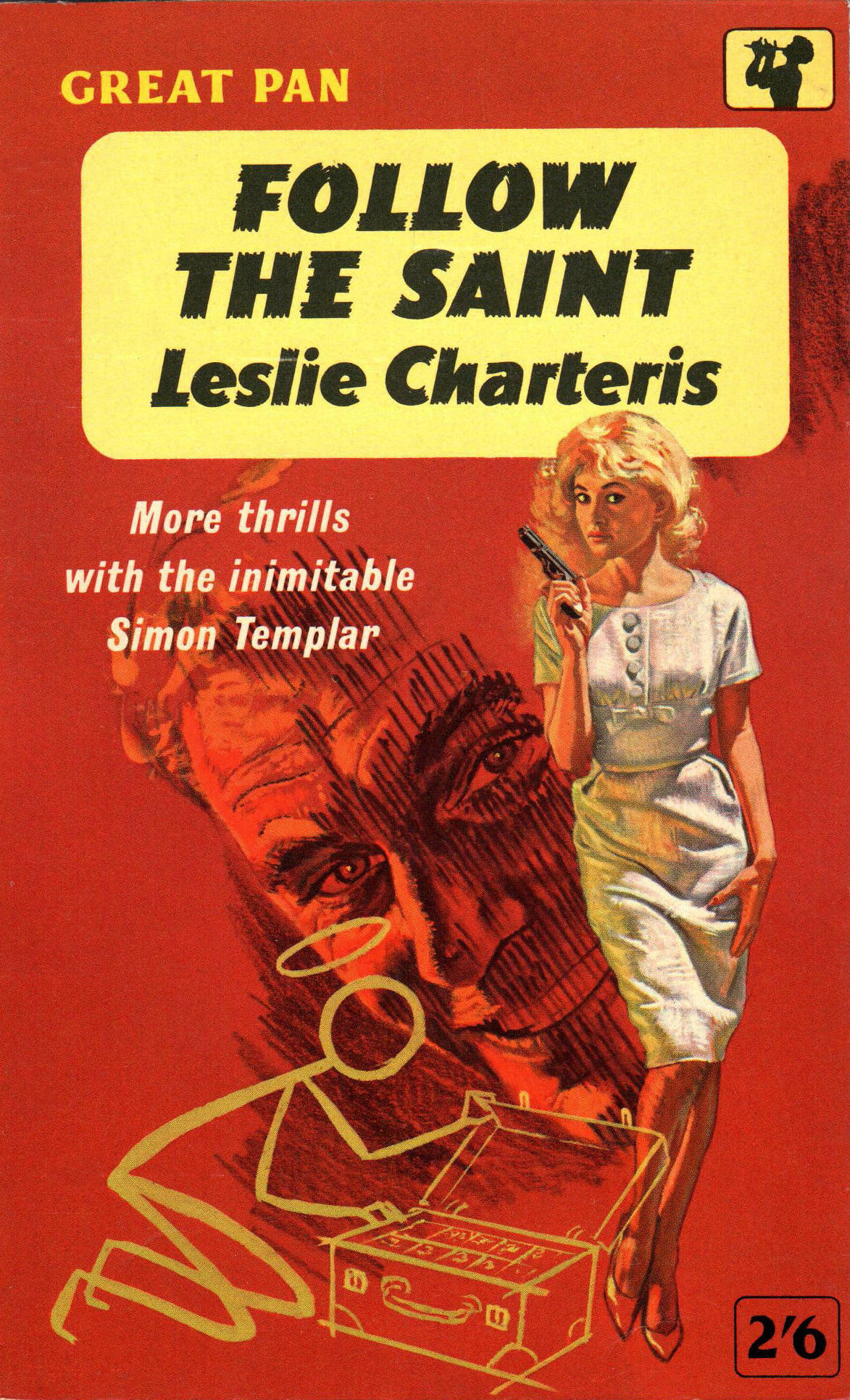
The Saint in Miami, by Leslie Charteris (Avon, 1958).
Cover illustration by David Stone.


Is it mere coincidence that Halloween, which so often celebrates haunting and horrific characters, should be followed by All Saints’ Day, honoring “saints both canonized and unknown”? This Christian solemnity began working its way onto the liturgical calendar in the 9th century A.D., and was pegged to November 1 through the efforts of Pope Gregory III in the early 8th century.

But, of course, we have our own, non-religious interpretation of what sort of saint is really deserving of praise today.

That’s right, we’re talking about Simon Templar, alias “The Saint,” a Robin Hood-like protagonist who was introduced by British author Leslie Charteris in his 1928 novel, Meet the Tiger. Templar went on to star in three dozen more novels and short-story collections by Charteris until 1963. After that, other writers either collaborated with Charteris on Saint works, or—following the author’s death in 1993—penned Saint tales on their own. In addition, the hero featured in big-screen films as well as TV movies, and was portrayed by actor Roger Moore in a 1962-1969 ITV-TV spy thriller series titled simply The Saint. (A subsequent show, Return of the Saint, was broadcast from 1978 until 1972 and found Ian Ogilvy in the lead role.)

Below you will find covers from half a dozen Saint titles published during the 1950s and ’60s. We don’t have identifications of all the artists responsible for these. However, we can tell you that Charles Binger created the front for The Saint to the Rescue (Permabooks, 1961), George Ziel was responsible for Concerning the Saint (Avon, 1958), and Raymond Johnson produced the artwork for the edition shown here of The Saint Steps In (Avon, 1954).

Many more Saint paperback fronts can be enjoyed here.


Tuesday, August 9, 2022

Casting a Wide Net for Links

• Raymond Johnson’s art featured regularly on mid-20th-century paperback covers, particularly those in the crime- and science-fiction categories. I’ve showcased Johnson’s paintings a number of times in Killer Covers, but have always been curious to know more about the artist himself. So I was excited to hear that Rubén “DaCollector” Azcona, a regular contributor to the private Today’s Inspiration Facebook Group page, would be conducting a YouTube interview with Lowell Wilson, author of a beautiful new feature in Illustration Magazine about Johnson. Their exchange can now be seen here in its 2.5-hour entirety. Wilson shares myriad examples of Johnson’s work, some of which graced more than one paperback front, and a few I didn’t know were done by Johnson. Promptly after watching this interview, I ordered a copy of the Illustration Magazine (#77) in which Wilson’s profile appears. How could I pass it up?

• I love it when the blog Pulp International delivers its irregular cover-theme posts. The latest one collects “vintage paperback covers featuring characters on both the giving and receiving ends of knives—or knifelike tools such as icepicks.”

• Speaking of art themes, Paperback Palette blogger Jeff Christoffersen looks back here at artist Rudy Nappi’s many Nancy Drew (ND) covers. As he explains, “In 1952, Rudy Nappi was assigned by publisher Grosset & Dunlap to create cover art for their original Nancy Drew Mystery Stories. He concluded his stint in 1979 with what is considered to be the final volume in the original series, volume 56. … Nappi tried to honor the original existing cover art wherever he could, while also updating Nancy’s look as per his publisher’s instructions. Eventually, he followed his own instincts, and his wife’s, who actually read the books on his behalf, composing new scenes for some titles, and on others actual montages, a first for the series. Nappi painted most of these with gouache on board. Along a similar vein, and coinciding with the ND’s, Nappi produced more than 58 of the original Hardy Boys series covers for the same publisher.”

• For the blog Kevin’s Corner, author James R. Benn relates some of the history behind the covers featured on his World War II-era Billy Boyle books, including the 17th and latest installment, From the Shadows, due out next month from Soho Crime.

• Here’s another good reason to go on living! Robert Deis and Wyatt Doyle, who have already published handsomely illustrated volumes about artists Samson Pollen and Mort Künstler, are preparing to release a new book focused on Brooklyn-born painter George Gross (1909-2003). Gross, writes Deis, “was one of the greatest of the many great illustration artists who created cover and interior illustrations for the men’s adventure magazines … In the 1950s, 1960s and 1970s, Gross was also a top cover artist for paperbacks.” The authors debuted George Gross: Covered at the recent PulpFest in Pittsburgh, but haven’t yet made it available on Amazon, Book Depository, or other sales sites. Deis says he’ll post a preview of the work in his blog soon. Watch for it!

• Finally, Michael Stradford, the man behind Steve Holland: The World’s Greatest Illustration Art Model and Steve Holland: Cowboy, reminds us that not only did Holland serve as the model for “Doc Savage, The Spider, The Phantom, The Avenger, countless cowboys and other iconic fiction characters,” but he was also cast as “television’s first ‘Flash Gordon.’” Holland, of course, filled the boots of comic-strip artist Alex Raymond’s space adventurer in the DuMont Network’s 1954-1955 series Flash Gordon. If you’ve never seen any of that show’s 39 half-hour episodes, you’re in luck: Stradford has embedded a colorized example in his post here.

Saturday, December 25, 2021

The Twelve Dames of Christmas, 2021: #1


After posting two showcases of vintage paperback book covers featuring “Dame” in their titles—first in 2016, and again in 2018—I pretty much used up my resources. But then I remembered that I still had a wide variety of book fronts sporting “dame” in their cover teaser lines. So this morning, as my distinctive way of honoring the legendary “12 days of Christmas” (December 25 to January 5), I am posting the first of what will be a dozen fronts with “dame” superimposed somewhere amid their artwork.

Harry Charles “H.C.” Witwer (1890-1929) was an Athens, Pennsylvania-born journalist, short-story author, and comic-strip writer. Before being hired as a reporter for newspapers (among them the Brooklyn Eagle and The Sun, both in New York City), he worked as a boxing manager, and later penned boxing yarns for Collier’s magazine. His boxing novel, The Leather Pushers, was originally published (by Grosset & Dunlap) in 1921. As Thomas Hauser explained in his review of that book, posted several years back in a fight-focused blog called The Sweet Science,
The story is told in the first person by an unnamed narrator, a likable rogue who manages a young heavyweight prospect named Kane Halliday a/k/a Kid Roberts. It’s pulp fiction with a plot and ring action that are melodramatic to the point of being unbelievable. But Witwer had a wonderful way with words and conveyed the essence of boxing in a manner that encouraged the reader to suspend disbelief.
The Internet Archive offers the full novel here.

Interestingly, a silent film serial, likewise titled The Leather Pushers and inspired by Witwer’s popular boxing fiction, debuted in 1922. It was scripted, at least in part, by future movie producer Darryl F. Zanuck. That series employed a protagonist named Kane Halliday, too, though it’s not at all clear how closely it followed the plot of Witmer’s novel; episodes are said to have been self-contained and complete in their own right. It’s equally unclear as to how many of those two-reel installments were shot: Wikipedia puts the number at 18, but the Internet Movie Database (IMDb) says there were only half a dozen. In any case, prints of only a trailer for the series and two episodes—viewable here and here—are known to still exist.

The lovely paperback edition of Witwer’s The Leather Pushers featured atop this post was published by Popular Library in 1950. Its cover was painted by Earle K. Bergey. If you would like to read the plot description on the back of that book, simply click here.

Tuesday, January 17, 2017

Executive Showdown


(Above) Title page illustration by Joseph R. Veno.

Irving Wallace penned his fourth novel, The Man, at the height of America’s civil-rights movement, as battles were being fought (in the courts and in the streets) to curtail racial prejudice in housing, employment, education, and voting rights. The Man first reached print as a Simon & Schuster hardcover in 1964, the same year President Lyndon B. Johnson, a Democrat from Texas—once part of the slave-holding, breakaway Confederate States of America—signed into law a civil-rights bill that, as Wikipedia explains, “banned discrimination based on race, color, religion, sex, or national origin in employment practices and ended unequal application of voter registration requirements and racial segregation in schools, at the workplace, and by public accommodations.”

It didn’t seem possible back then, almost half a century ago before the rise of Barack Obama, that an African American could be elected as president of the United States. Few people would have even bothered imagining such a thing. But Wallace was one of them.


Douglass Dilman is sworn in as president.

The Chicago-born Hollywood screenwriter turned author had previously produced novels about a straying husband frustrated by impotence (The Sins of Philip Fleming, 1959), female sexuality (The Chapman Report, 1961), and the annual awarding of Nobel Prizes (The Prize, 1962). He was well on his way to becoming a best-selling author of sex-drenched potboilers, such as 1974’s The Fan Club. As The New York Times remarked in its 1990 obituary of Wallace (who died of pancreatic cancer at 74 years of age), his fiction offered “a judicious sprinkling of adultery, rape, kidnapping, old-fashioned romance, suspense, babbitry, alcoholism, intrigue and assorted examples of venality”—and sold in excess of 120 million copies during his lifetime.

The Man—a 1965 Reader’s Digest condensed version of which supplies the artwork decorating this post—is something different from its predecessors. There isn’t a great deal of carnal cavorting in its 750-plus pages, but plenty of political chicanery; not much romance, but more than enough white-privilege arrogance and vicious bigotry for most anyone’s taste.

(Left) Secretary of State Eaton gets acquainted with Sally Watson.

It begins with an official visit to Frankfurt, West Germany, during which a freak accident takes the lives of both the U.S. president and the speaker of the House. The vice president has recently perished from a “massive coronary,” and in the absence of the Twenty-fifth Amendment to the U.S. Constitution—which in 1967 would set forth procedures by which America’s top political offices were to be filled in the event of death or physical disabilities—the presidency falls to Douglass Dilman, a former college professor and junior senator from a Midwestern state, who also holds the ceremonial post of president pro tempore of the Senate. Dilman has no White House aspirations; as actor James Earl Jones (who portrayed Dilman in a 1972 film based on Wallace’s book and scripted by Twilight Zone’s Rod Serling) observed in his introduction to the 1999 edition of The Man, Dilman is “a quiet, rational man trying his best to do a difficult job in daunting circumstances. Thrown into the center of a political earthquake, he is an apolitical creature, and something of a Milquetoast. He is an intellectual, and a good man with a commitment to principles but no appetite for political battles.” Wallace described his protagonist as someone “who was not white and who was afraid of being black, and who was without armor or grace.” Yet this is the guy who becomes the new president.


White House cronies plot against Dilman.

Unlike Harry Truman or Lyndon Johnson, who also acceded to the Oval Office after the untimely deaths of popular 20th-century chief executives, “the country doesn’t rally around” new President Dilman, recalled Florida English professor Ariel Gonzalez in this 2011 review of The Man: “sixty-one percent disapprove of him.
Dillman can’t fault them; he holds a low opinion of himself too. Racial insecurity bedevils him. “I am a black man,” he says, “not yet qualified for human being, let alone for President.” Though a widower, he is reluctant to pursue a relationship with a biracial woman because he fears the lightness of her skin will raise the specter of miscegenation. To calm people’s worries, he agrees to play the role of a figurehead. He doesn’t even veto a clearly unconstitutional bill prohibiting him from removing any member of his predecessor’s Cabinet.
Only slowly, with almost painful hesitation, does Dilman grab hold of the reins that have been thrust into his hands, raising the rancor of his opponents on all fronts. There’s an assassination attempt in the White House Rose Garden; African-American radicals protest against Dilman as a “black Judas,” “a Jim Crow president” who refuses to stand up for his race; and the imperious, Ivy League-educated secretary of state, Arthur Eaton—convinced that he deserves the presidency more than Dilman—conspires with his worshipful, younger mistress, White House social secretary Sally Watson, to glean information for use against Dilman. The president’s enemies finally manufacture pretexts on which to commence Congressional impeachment hearings against him; and then, employing some of the most racist verbiage heard outside of a Ku Klux Klan rally, they go on public attack against Dilman’s morality and fitness for office.

(Right) Black students protest Dilman’s sudden rise.

Particularly venomous, during and outside of those hearings, is Congressman Zeke Miller, a newspaper publisher and “Southern redneck mouthpiece,” who denounces Dilman as an “all-fired ignoramus of a nigger … fixing to make [the United States] into another Africa.” Appealing to Eaton for his assistance in bringing down the accidental president, Miller reveals the odious depths of his contempt for Dilman:
“We’re going to put old Sambo on the hot seat good, and we’re going to roast his ass plenty, until he yells enough, and begs us to get him off it. I’m going to force him to resign, to resign because of disability or whatever, but to resign, and if he refuses, I’m going to resign him by force.”
It would be comforting to think that such hidebound attitudes and low-minded hatreds were things of the past, that by the 21st century America had come to realize the value of its population diversity. But as eight years of racially charged and increasingly ludicrous impeachment talk against Democratic President Barack Obama demonstrated, and as Republican Donald Trump’s divisive recent White House campaign confirmed, this is still a country held hostage by ethnic and sexual prejudices, all of them lurking just below the surface, barely held at bay by public norms.


An attempt on Dilman’s life in the Rose Garden.

According to Jones’ introduction, “in 1963, as background for The Man, [Wallace] accepted an invitation from President John F. Kennedy to spend several days observing life in the White House, from the Oval Office to the Cabinet Room to the private family quarters.” The result is a tale redolent of authenticity, with details of the president’s Pennsylvania Avenue residence and business habits tossed off with all the studied casualness one might have found in an episode of The West Wing. While the back-and-forth of Dilman’s impeachment proceedings can be tedious at times, burdened with the turgid declarations of politicians seeking the limelight, Wallace does a fine job of ratcheting up tensions between Dilman’s treacherous accusers and the sharp but shy president. “The writer keeps you angry long enough to make the retribution sweet,” wrote reviewer Gurdas Singh Sandhu in this 2007 post for his blog, Guldasta. “The sheer audacity of lies, the shameless hatred veiled in goodness, and the vocal mudslinging is just perfect to get the reader angry. And angry I was! So much so that while reading the book, there were instances when I had to keep it aside and allow the torrential anger inside me (at the injustice meted out to Doug) to subside.”

Although The Man doesn’t achieve the heights of American political fiction reached by, say, Robert Penn Warren’s All the King’s Men, or rival Harper Lee’s To Kill a Mockingbird as a literary exploration of racial injustice, it certainly forced readers of the ’60s to confront the possibility of someone other than a white man occupying the Oval Office. Furthermore, it was prescient in envisioning the ugly belligerence that would greet an African American like Douglass Dilman or Barack Obama ascending to the presidency.

I didn’t catch up to The Man until 35 years after its initial publication, purchasing a paperback edition that was released by ibooks in 1999. I didn’t get around to actually reading the novel until 2015. And only last year did I happen across the illustrations peppering the length of this post. As I mentioned earlier, they were featured in a 1965 Reader’s Digest edition of Wallace’s yarn, which was combined in a single volume with condensations of William B. Walsh’s A Ship Called Hope, Joseph Hayes’ The Third Day, and John Ehle’s The Land Breakers. Aside from the title page, shown atop this post, the other paintings were done by Robert K. Abbett, an American artist I’ve mentioned a number of times in Killer Covers. You should find a full set of those illustrations here.

SEE MORE: At least for the time being, you can watch the 90-minute ABC-TV film based on The Man by clicking here.

Friday, November 18, 2016

Friday Finds: “It Can’t Happen Here”

Another in our growing line of vintage book covers we love.


There was a good deal of talk about Sinclair Lewis’ semi-satirical, 1935 political novel, It Can’t Happen Here, in the run-up to this month’s American presidential election, due to the fact that Lewis’ story features a tactless, fearmongering, Donald Trump-like character. Slate’s Jacob Weisberg mentioned it as “a novel today more referred to than read, which imagined fascism coming to the U.S. The movement’s leader is Buzz Windrip, a populist demagogue who promises ‘to make America a proud, rich land again,’ punish nations that defy him, and raise wages very high while keeping prices very low.” He goes on to remark:
You can’t read Lewis’ novel today without flashes of Trumpian recognition. Windrip is a demagogic huckster, “an inspired guesser at what political doctrines the people would like,” who understands how to manipulate the media and considers the truth an irrelevancy. His constituency of economically dispossessed white men moos at his xenophobic nationalism and preposterous promises. After he wins the 1936 election, Windrip moves to assert control over the press, lock up his opponents, and put competent businessmen in charge of the country.
In Salon, Malcolm Harris called Lewis’ book “a wonderful example of prophylactic fiction,” observing that “Lewis used his position as one of the nation’s top novelists”—he had penned Main Street (1920), Babbitt (1922), and Elmer Gantry (1927), after all—“to show his countrymen exactly how authoritarianism could rear its head in the land of liberty. The assassination of Louisiana Governor Huey Long (better remembered in literary history for inspiring Robert Penn Warren’s All the King’s Men) and the re-election of Franklin Roosevelt rendered Lewis’ warning moot for a time, but 80 years later the novel feels frighteningly contemporary.”

It’s been a long while since I read It Can’t Happen Here; but Wikipedia’s plot description reminds me of the tale’s most significant and frightening turns:
Though having previously foreshadowed some authoritarian measures in order to reorganize the United States government, Windrip rapidly outlaws dissent, incarcerates political enemies in concentration camps, and trains and arms a paramilitary force called the Minute Men, who terrorize citizens and enforce the policies of Windrip and his “corporatist” regime. One of his first acts as president is to eliminate the influence of the United States Congress, which draws the ire of many citizens as well as the legislators themselves. The Minute Men respond to protests against Windrip’s decisions harshly, attacking demonstrators with bayonets. In addition to these actions, Windrip’s administration, known as the “Corpo” government, curtails women’s and minority rights, and eliminates individual states by subdividing the country into administrative sectors. The government of these sectors is managed by “Corpo” authorities, usually prominent businessmen or Minute Men officers. Those accused of crimes against the government appear before kangaroo courts presided over by “military judges.” Despite these dictatorial (and “quasi-draconian”) measures, a majority of Americans approve of them, seeing them as necessary but painful steps to restore American power. Others, those less enthusiastic about the prospect of corporatism, reassure themselves that fascism cannot “happen here,” hence the novel’s title.

Open opponents of Windrip, led by Senator [Walt] Trowbridge, form an organization called the New Underground, helping dissidents escape to Canada in manners reminiscent of the Underground Railroad and distributing anti-Windrip propaganda. One recruit to the New Underground is Doremus Jessup, the novel’s protagonist, a traditional liberal and an opponent of both Corpoism and communist theories, which Windrip’s administration suppresses. Jessup’s participation in the organization results in the publication of a periodical called The Vermont Vigilance, in which he writes editorials decrying Windrip’s abuses of power. Shad Ledue, the local district commissioner and Jessup’s former hired man, resents his old employer and eventually discovers his actions and has

Sinclair Lewis
Jessup sent to a concentration camp. Ledue subsequently terrorizes Jessup’s family and particularly his daughter Sissy, whom he unsuccessfully attempts to seduce.
I won’t give away the whole story, but I will mention that Windrup’s authoritarian chokehold on power is eventually undermined by reports that the economic prosperity he’d promised to bring the United States fails to materialize. As more and more people become disillusioned with the Windrup administration, rivalries break out among his lieutenants, a gratuitous war on Mexico destroys what remained of the public’s faith in the “Corpo” dictatorship, and civil war breaks out as voters realize they have been conned into believing lies told by charismatic but self-serving politicians.

I don’t own the 1961 Dell paperback edition of Lewis’ yarn shown atop this post, but it features a cover painting by the now 89-year-old, Illinois-born artist Howard Terpning, another of whose book fronts I applauded in an earlier “Friday Finds” post.

Sixty-nine years after Sinclair Lewis’ novel first saw print, the what-if scenario of fascistic forces overrunning the U.S. government cropped up once again in Philip Roth’s better-written The Plot Against America (2004), which imagined celebrity aviator Charles Lindbergh, running as a Republican, defeating Democratic President Franklin D. Roosevelt in 1940 and bringing his fringe agenda to the White House. “Lindbergh, in real life as in the novel, famously admired Hitler and even accepted a medal from Hitler’s government,” observed Paul Berman in his New York Times review of this book. “He looked on the American Jews as a pretty suspicious group, all in all. Even so, millions of other Americans admired him.”

Before the release of Roth’s book, though, in 1968, ABC-TV broadcast a “movie of the week”/series pilot titled Shadow on the Land, which was inspired by It Can’t Happen Here and found “freedom fighters” battling fascism across the United States. That teleflick was written by Sidney Sheldon and Nedrick Young, and starred John Forsythe, Jackie Cooper, Carol Lynley, and Gene Hackman. Although it’s not easy to find anymore, if you act quickly, you can watch it on YouTube. There’s no telling how long it might remain available.

READ MORE: “Amazon’s Best-Seller List Takes a Dystopian Turn in Trump Era,” by Brian Stelter (CNN Media); “President Donald J. Gantry: On the Prescience of Sinclair Lewis,” by Jacob Lambert (The Millions).