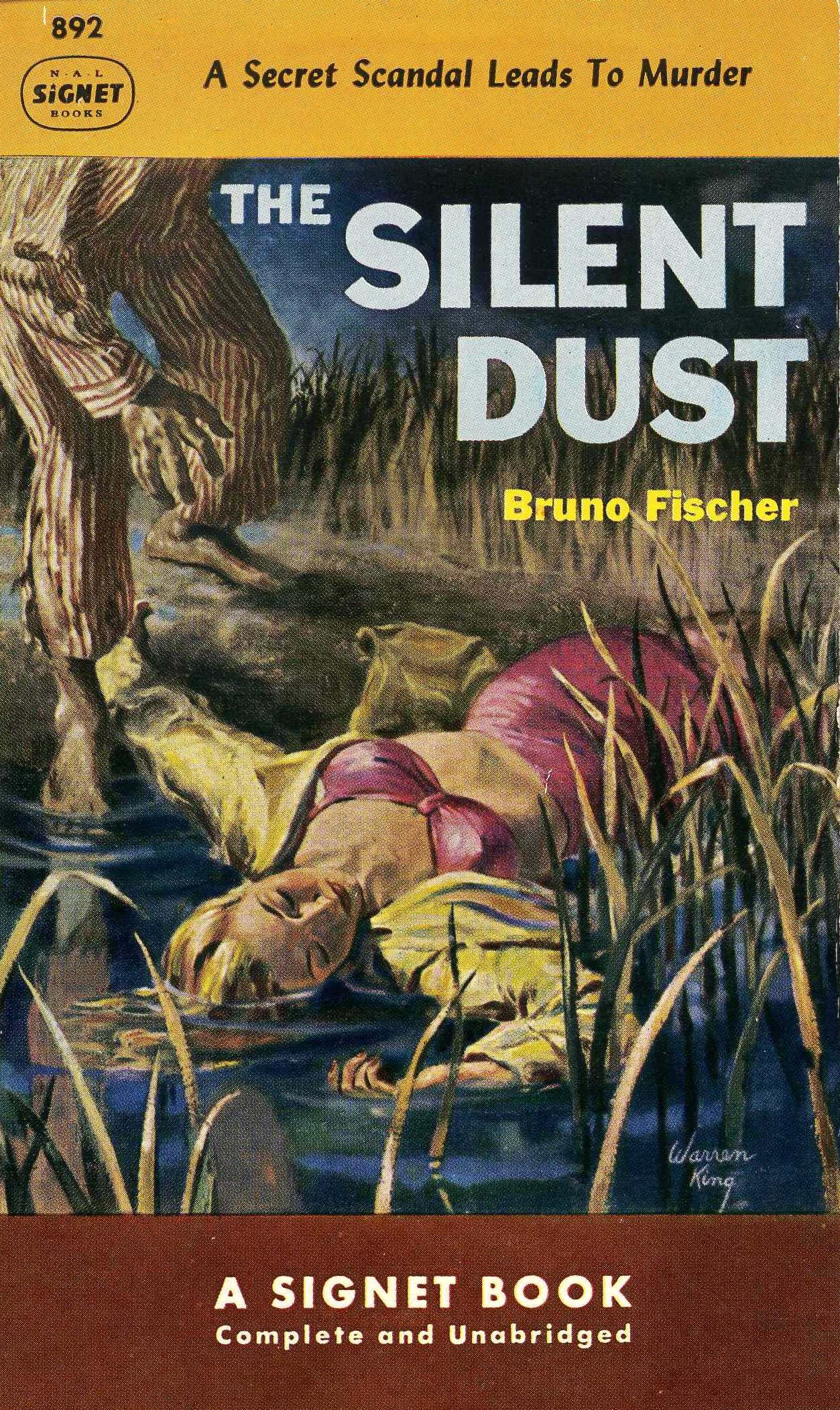
The Silent Dust, by Bruno Fischer (Signet, 1951). This was the fourth of five Fischer novels to feature Ben Helm, an ex-cop turned private investigator in New York City.
Cover illustration by Warren King.


Legal clerk Jim Steele VC is horrified when told by Eunice Weldon, the girl he loves, that she has taken the post of secretary to the mother of Digby Groat and is going to live in the Groat family home in [London’s] Grosvenor Square.The cover of Blue Hand shown above and on the left comes (quite ironically) from UK publisher Digit Books’ 1963 paperback edition of Wallace’s tale. There is no apparent artist’s signature on the cover, and I don’t find any reference online to who might have created that painting of an apparently frightened blonde woman, a scrubs-sporting doctor, and a menacing azure palm spread above them both. It’s been suggested that this illustration came from the most able hands of Sam Peffer, a British commercial artist who took on a variety of cover-art-creation assignments for Digit during the early ’60s, and once explained that he didn’t sign all of his work for that house. But I don’t find confirmation that Peffer—or “Peff,” as he liked to be identified—gave us this Blue Hand art.
As well Jim might [be] … Among other things, [Digby Groat] is not above menacing his kleptomaniac mother and torturing small animals. His mother will inherit a fortune from her deceased brother on a certain date if her niece Dorothy Danton cannot be found. Since Dorothy disappeared in a boating accident while still a baby, and has not been seen since, it looks as if the Groats will soon be extremely wealthy. But Jim, who is interested in the Danton case, is determined they will never get their hands on the fortune.
The first night under the Groats’ roof, Eunice receives an unseen nocturnal visitor who leaves a card stamped with a blue hand, advising her to flee the house. Despite this ominous warning, after Jane Groat suffers a stroke Eunice stays on. Other blue hand marks appear at the house and soon the reader is in the thick of a plot featuring a mysterious veiled woman, drugs, gangs, derring-do on trains, in planes, and on the high seas, and a lot more besides. Aside: if this had been a film, no doubt the audience would cheer when they see how a minor baddie comes to a particularly spectacular end.
 starring cop-turned-private eye Ben Helm. As Kevin Burton Smith observes at The Thrilling Detective Web Site, Helm was “not your typical hard-boiled, Hammeresque eye of the time.” He smoked a pipe, was married to a “loving, striking actress” named Greta Murdock, and earned “much of his living as a criminologist, writing and lecturing in that field.”
Tony Bascomb was the town’s black sheep. He had run away from a murder, and now he was back, and the night after he got back there was another murder.There’s no mention in that text of New York City gumshoe Helm. But then, as The Thrilling Detective’s Smith makes clear, Fischer’s protagonist is “rarely the central character in these multiple-viewpoint thrillers, although he does always seem to be the one to (mostly) tie things up.” Presumably, he sweeps in at some point to accomplish the same thing here.
George Dentz was the town’s frustrated lover. The poetic type. Liked women, in his own nervous way. Capable of cold-blooded murder? Nobody knew.
Mark Kinnard was the town’s hard worker. A big fellow, friendly, a quiet, dutiful son. He’d never had much fun. Hardly the killer type.
Rebecca Sprague was the town’s beauty. These three men wanted to marry her, but two women had been strangled, and one of the three was the slayer. Nobody knew which, least of all Rebecca.
She had a choice: lose the man she loved, or take a 3-to-1 chance on marrying a brutal killer!


 Killer Covers is a companion project of The Rap Sheet, a news and features resource for crime-fiction fans, edited by J. Kingston Pierce.
All text © 2009-2026 by Killer Covers or its individual contributors.
Killer Covers banner by Rob Kelly.





