Saturday, January 29, 2022

Another Look: “They Came to Baghdad”

Warning: Artistic inspiration drawn from book titles may vary.


Left: They Came to Baghdad, by Agatha Christie (Pocket, 1952); cover art by Clyde Ross. Right: They Came to Baghdad, by Agatha Christie (Fontana, 1954); an illustrator credit in the lower left reads only “Johnston.”

Wednesday, January 19, 2022

Lucky 13


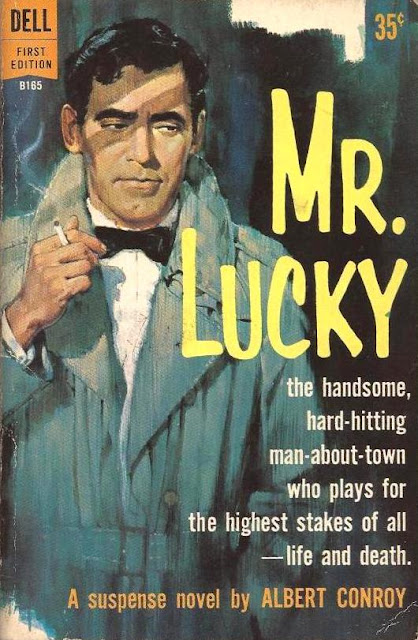
I can’t say that I have watched more than a few episodes of Mr. Lucky, the 1959-1960, Blake Edwards-created CBS-TV drama starring John Vivyan as an honest gambler and operator of a floating casino, with Ross Martin (later of The Wild Wild West) playing his right-hand man. Nor do I own the tie-in novel embedded above, the 1960 Dell release Mr. Lucky, by “Albert Conroy,” aka Marvin H. Albert (cover art by Mort Engel). But both came to mind as I thought about celebrating today’s 13th anniversary of Killer Covers’ launch.

The last year has been more trying than I had expected. This was partly due, of course, to the lingering COVID-19 pandemic, and partly because I’m extremely tired of working alone, bereft of office colleagues with whom I can bat ideas around and thereby help refine my thoughts on editorial coverage. Also discouraging—as I explained here earlier this month—was the fact that the exterior hard drive on which I had for so long been keeping much of my book-cover art, together with the vast majority of my video clips from old TV series, suddenly ceased operating. One day a few months ago, I went to retrieve something from those computer files … and nothing happened. The unit was plugged in, yet no electricity seemed to be reaching it. I hoped that my usual computer guru could fix things, tell me that all I needed was a new power cord, but he informed me that nothing could be done. I have spent more than a little time since, just trying to re-create files on which I have depended for posts in Killer Covers, The Rap Sheet, CrimeReads, and other sites.

Only with all of that done, can I finally look ahead to what the next year might bring. There are a couple of artist interviews I’d like to do for Killer Covers. In addition, I have in mind a few series of themed posts that should keep this blog’s readers entertained. And I want to get back to writing more regular pieces about individual paperback fronts of note. If I am lucky, all of those things will be possible.

Which brings me back to Mr. Lucky.

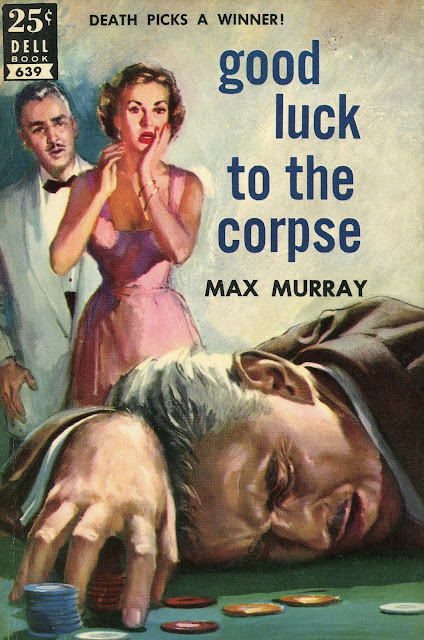
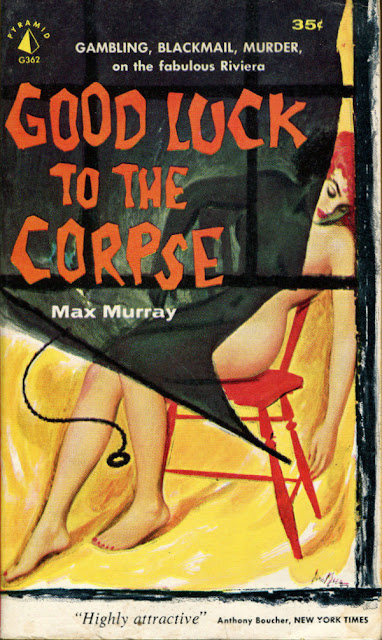
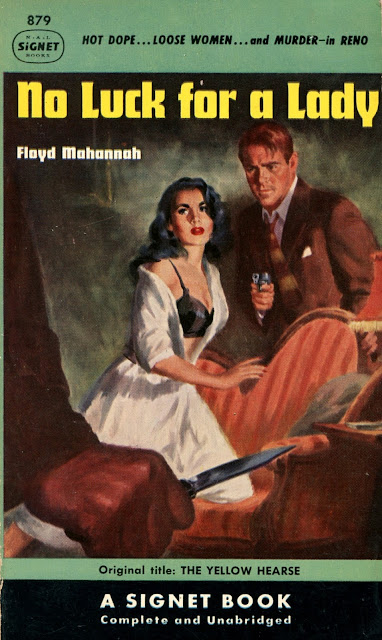
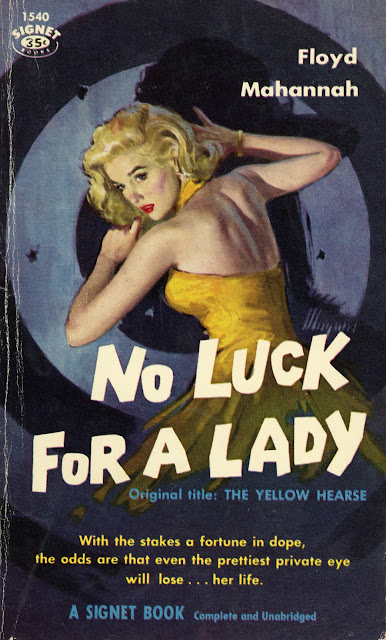
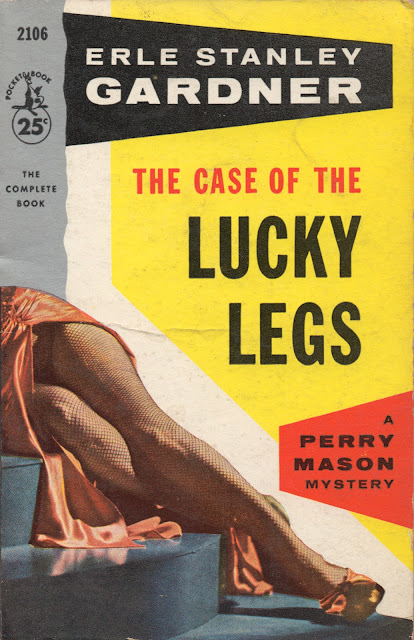
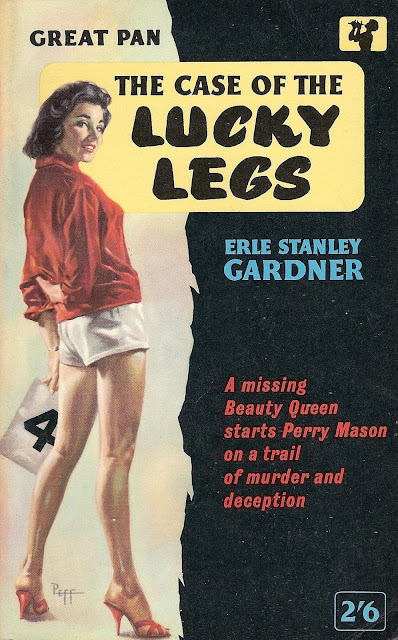
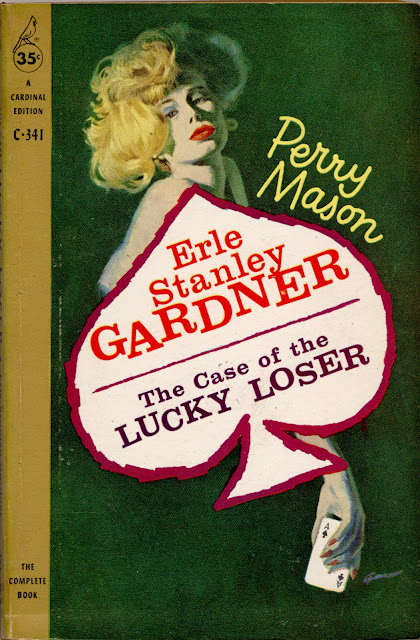
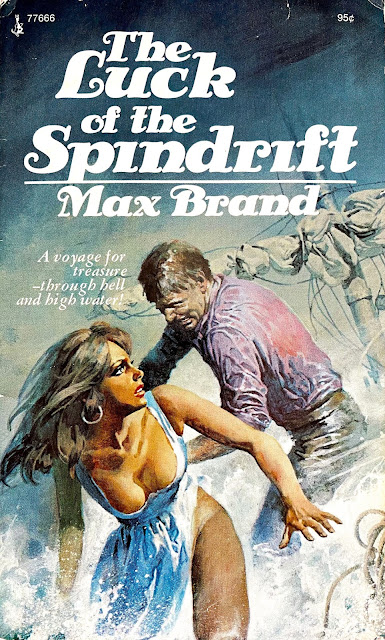
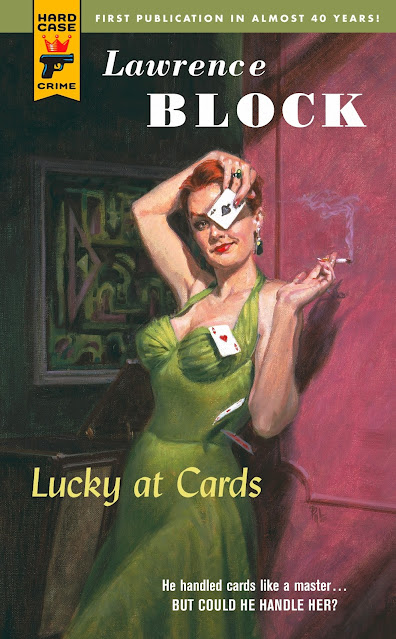
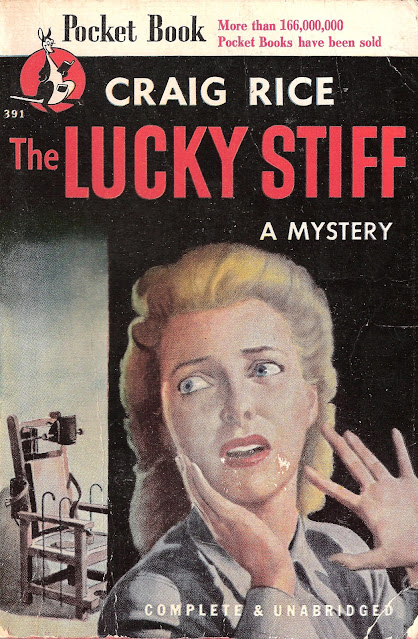
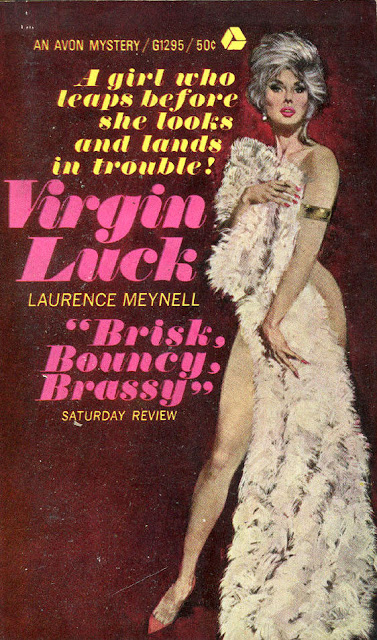
Despite occasional frustrations, I consider myself pretty damn fortunate to have found free time enough to keep Killer Covers going for these last 13 years. So let’s celebrate that success with 13 paperbacks that include “luck” in their titles. The fronts below feature the work of such artists as James Meese (the first Good Luck to the Corpse, 1952), Robert Maguire (the second No Luck for a Lady, 1958), Sam Peffer (the second Case of the Lucky Legs, 1960), Darrel Greene (The Case of the Lucky Loser, 1959), Chuck Pyle (Lucky at Cards, 2011), and Ron Lesser (Virgin Luck, 1960).

Let me just thank everyone who has followed Killer Covers over these last 12 months, ever since the blog’s last anniversary. With any luck, we’ll all be around for many years—and many covers—to come.


Wednesday, January 5, 2022

The Twelve Dames of Christmas, 2021: #12

Celebrating this festive season with brassy bombshells.


Calamity Fair, by “Wade Miller,” aka Robert Wade and Bill Miller (Signet, 1961). This was their fourth entry in a six-part series starring San Diego private eye Max Thursday.

Cover illustration by Mitchell Hooks.

My, That Went by Quickly

Today ends the storied Twelve Days of Christmas, which run from December 25 to January 5 (though some religious traditions extend it to the sixth of January). And so we also conclude Killer Covers’ latest tribute to the darling and daring dames of vintage paperback fronts. This series’ final entry will appear early this afternoon.

I’ll be interested to see what I can do along this same line in the future. A few months ago, my computer’s exterior hard drive, on which I’d been storing so many of my book-cover images, decided to cease functioning (throwing a number of projects into disarray). I have since re-created many of the files housed on that compact unit, but not all. And I haven’t come across any new novels with the word “dame” in their titles or their cover lines. I shall endeavor to dig up more, but it may be a year or two before I can present another “Twelve Dames of Christmas” feature here. Then again, doing this annually might make it more of a task and less enjoyable.

Here’s hoping 2022 will give us all cause to remember it fondly!

Tuesday, January 4, 2022

The Twelve Dames of Christmas, 2021: #11

Celebrating this festive season with brassy bombshells.


The Velvet Ape, by David C. Holmes (Permabooks, 1958). After he died on June 26, 2004, an obituary in The Washington Post recalled that Holmes was “a retired Navy captain who wrote fiction and nonfiction books.” A native of Spokane, Washington, he’d graduated from the U.S. Naval Academy and “served on destroyer-mine sweepers in the Pacific during World War II. He became a naval aviator in 1947 and later was part of a hurricane-hunter squadron. His specialty became guided missile systems. His final active duty assignment was at the Washington Navy Yard. In the 1970s and 1980s, he did consulting work for the Naval Research Lab on the global positioning satellite program.” In addition to The Velvet Ape, about a pilot who takes on a hazardous assignment in Central America (read the back-jacket copy here), Holmes wrote 11 other books, including Young People’s Book of Radar (1951), The Story of Weather (1963), and The Search for Life on Other Worlds (1966). He was 84 years old when he breathed his last in Annapolis, Maryland.

Cover illustration by James Meese.

Monday, January 3, 2022

The Twelve Dames of Christmas, 2021: #10

Celebrating this festive season with brassy bombshells.


The Violent Lady, by Michael E. Knerr (Monarch, 1963). Many years ago, science-fiction writer and editor John F. Carr explained in Mystery*File that Knerr was “born on May 31, 1936, in Williamsport, PA ... He was a hunter, Civil War re-enactor, horseman, built flintlock rifles, and loved boats and sailing. Mike was a former newspaper man ([with] the Shamokin [Pennsylvania] newspaper), and in 1973 moved permanently (except for a short time in Woolrich, PA) to Southern California, specifically Alameda, Sausalito and L.A.” Among Knerr’s early works were Travis (1962), which introduced Mike Travis, a Travis McGee-like “sailor of fortune” turned private investigator; something called Operation Lust (1962); and a straight-out soft-core porn novel titled The Sex Life of the Gods (1963). The Violent Lady, which also first appeared in ’63, sounds more like a hard-boiled crime yarn, if you go by this back-cover plot description:
You’re Clint Sheldon, a man with a mission—to raise the $6,000 to save your 49-foot yawl, Restless.

So you charter the ship out to Malvino Gia and his hot-eyed wife, Lois. But once under sail you find out they aren’t after pleasure; they’re after treasure—$250,000 worth of jewels lying at the bottom of the sea—and they need you to get it.

But you nix the deal. Only Gia pulls a gun and you’re forced to go along. Then Lois comes to you with a proposition. All you have to do is help her double-cross Gia and you can walk off with the loot—and her.

Suddenly you find yourself in a tight squeeze between Gia’s gun, Lois’ charms and Hurricane Donna’s fury. Now you stand to lose the dame, the dough and the debt you owe unless you can find a way to get out before all hell breaks loose.
Knerr went on to produce such now-forgotten books as the 1977 horror yarn Sasquatch: Monster of the Northwest Woods and Suicide in Guyana (1979), a non-fiction recounting of the 1978 mass-murder suicide of cult leader Jim Jones’ followers in Guyana. He reportedly died in 1999 at age 64.

Cover illustration by Harry Barton.

Sunday, January 2, 2022

The Twelve Dames of Christmas, 2021: #9

Celebrating this festive season with brassy bombshells.


The Big Make, by “Gene Paul,” aka Paul Conant (Lion Library, 1957). According to Allen J. Hubin’s Crime Fiction IV: A Comprehensive Bibliography, 1749-2000, author Paul Eugene Conant was born in San Bernardino, California, in 1906; worked as “a copy reader in Fort Lewis, Washington, in 1942”; and died in New York in 1968. He may be remembered best for publishing, under his own name, a 1952 mystery titled Dr. Gatskill’s Blue Shoes. In addition, though, he released three crime novels as part of editor Arnold Hano’s once-notable Lion Books paperback line (1949-1955): Little Killer (1952), Naked in the Dark (1953), and finally The Big Make, which was actually Little Killer under a fresh title. Click here to read the back-cover copy.

Illustration by Robert Maguire.

Saturday, January 1, 2022

The Twelve Dames of Christmas, 2021: #8

Celebrating this festive season with brassy bombshells.


The Best Go First, by “Frank O’Malley,” aka Frank O’Rourke (Bantam, 1952). A novel with “first” in its title seems appropriate for this New Year’s Day, don’t you think?

Author O’Rourke is remembered now as the “King of the Westerns,” thanks to the numerous works he produced in that genre, some of which—like 1957’s The Bravados—were adapted for the silver screen. However, he also published non-westerns under the pseudonyms Patrick O’Malley and Frank O’Malley. The Best Go First, described by Pulp International as “a detective thriller set in Texas involving oil money and murder,” was originally released in a 1950 hardcover edition by Random House. Two years later, it was reissued as a Bantam softcover.

There’s a faint signature in the lower right-hand corner of the cover shown above. It appears to read “Phillips,” leading many to conclude that the painting was done by prolific paperback artist Barye Phillips. Trouble is, he usually signed his work simply “Barye.” Another suggestion—based on this image’s style—is that it was created by renowned men’s adventure magazine illustrator Wil Hulsey, who is described by one Twitter user as “the undisputed king of the animal attack pulp cover. You name it, he'd paint it attacking you in a pool of stagnant water.” Hulsey didn’t usually attach his moniker to his work, so comparing this signature with other examples isn’t terribly straightforward. It’s not impossible that what looks to be a “P” at the start of that autograph is actually an elaborate “H.”

But I’ll leave responsibility for determining proper credit to others. In the meantime, if you would like to see the back cover of this 1950 paperback, click here.