Assignment: Seduction, by “George Cassidy,” aka William E. Vance (Merit, 1963). Vance wrote primarily westerns under his own name, but used the Cassidy pseudonym when penning what we now fondly refer to as “sleaze fiction” (The Flesh Market, Bait, Wanton Bride, etc.). Illustration by Robert Bonfils.
Showing posts with label Robert Bonfils. Show all posts
Friday, December 31, 2021
The Twelve Dames of Christmas, 2021: #7
Celebrating this festive season with brassy bombshells.

Assignment: Seduction, by “George Cassidy,” aka William E. Vance (Merit, 1963). Vance wrote primarily westerns under his own name, but used the Cassidy pseudonym when penning what we now fondly refer to as “sleaze fiction” (The Flesh Market, Bait, Wanton Bride, etc.). Illustration by Robert Bonfils.
Labels:
12 Dames of Christmas,
Robert Bonfils
Friday, January 4, 2019
The Twelve Dames of Christmas, 2018: #11
Celebrating this festive season with brassy bombshells.

The Way of a Dame, by Fletcher Bennett (Playtime, 1963). Click here to see the back cover. Illustration by Robert Bonfils.

The Way of a Dame, by Fletcher Bennett (Playtime, 1963). Click here to see the back cover. Illustration by Robert Bonfils.
Labels:
12 Dames of Christmas,
Robert Bonfils
Saturday, December 22, 2018
Favorite Finds: “The Hellions”
Top vintage book fronts added to my collection in 2018.

The Hellions, by “Tony Calvano,” aka Thomas P. Ramirez (Leisure, 1965). Cover art by Robert Bonfils—of course.

The Hellions, by “Tony Calvano,” aka Thomas P. Ramirez (Leisure, 1965). Cover art by Robert Bonfils—of course.
Labels:
Favorite Finds 2018,
Robert Bonfils
Tuesday, August 21, 2018
A Last Blast of Summer Delights

It seems there’s no end to the number of interesting, provocative, and downright amusing book fronts boasting a summertime or at least a beach theme. In June 2009, I posted in this blog a selection of more than two dozen such covers. Three years ago, I added significantly to that collection, bringing the total number of images up to 91. Today, I have 39 more to present, most of them suggesting that this season of sun is also a ripe season for sin.
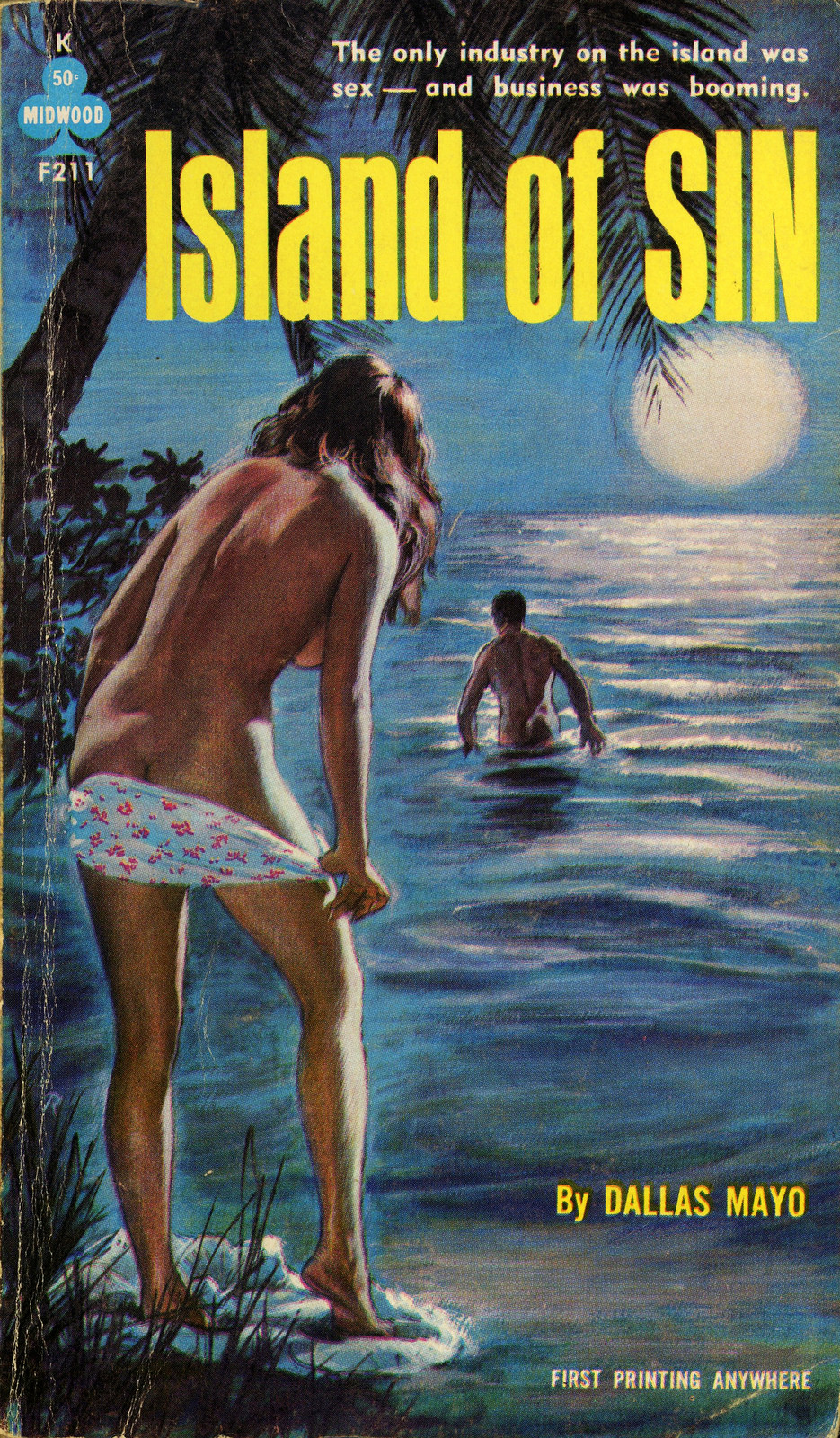
Among the artists represented in this adjunct gallery are Robert McGinnis (The Limbo Touch, Dark Fury, and the recently talked-about Deadly Welcome), Robert Bonfils (Mix ’n’ Match Mates, Surfside Sex, Sex Is Like Money), Paul Rader (Blanket Party/Sultry Summer, Island of Sin), Glen Orbik (Scratch One), Fred Fixler (Two Way Beach Girl), Robert Maguire (Love Under Capricorn, Ah King), James Meese (The Dangerous One), Harry Schaare (Jungle Heat), Bill Edwards (Youth Against Obscenity), Robert Heindel (The Beach House), Mitchell Hooks (Hot Winds of Summer), Victor Olson (The Harem, Summer Set/Available), Michael Codd (The Last Night of Summer), and Richard Powers (Summer in Salandar).
Click on any of the covers here to open an enlargement.


Tuesday, March 14, 2017
Bodies, Bombshells, and Berlin

When I learned recently that lovely South African actress Charlize Theron would be starring in a movie titled Atomic Blonde, I was, well, more than a bit perplexed. After all, I associated that playful title with the notably racy 1963 paperback shown above, credited to author Monte Steele (which may or may not have been a pseudonym). As Michael Hemmingson explains in his blog, Those Sexy Vintage Sleaze Books, Steele’s yarn—which carries cover art by Robert Bonfils—focuses around a “tongue-in-cheek tough guy, murder, and lots of sex.” He goes on to offer this plot brief:
The narrator of Atomic Blonde is Johnny Stone, an insurance fraud investigator in Desert City, Nevada, who happens upon a platinum blonde bombshell with a flat tire and a pink Caddy. He offers to help fix the flat but she keeps telling him no; but, being the ladies’ man and gentleman he is, with the possibility of getting some blonde pussy, Johnny doesn’t listen to her—and when he opens her trunk to get the jack, he finds the … dead body of a man and a diamond head rattlesnake.As you might have surmised by this point, Steele’s “mindless entertainment” of a novel was not the inspiration for Theron’s Atomic Blonde. Instead, the screenplay was inspired by a 2012 graphic novel, The Coldest City, by Antony Johnston. Wikipedia says “the film takes place in Berlin, 1989, on the eve of the collapse of the Berlin Wall and the shifting of superpower alliances. Lorraine Broughton [Theron], a top-level spy for MI6, is dispatched to Berlin to take down a ruthless espionage ring that has just killed an undercover agent for reasons unknown. She is ordered to cooperate with Berlin station chief David Percival [James McAvoy], and the two form an uneasy alliance, unleashing their full arsenal of skills in pursuing a threat that jeopardizes the West’s entire intelligence operation.”
The blonde takes off in his car.
Then two thugs try to kill him—they keep trying to kill him throughout the book, which takes place in 48 hours.
In that 48 hours, Johnny has sex with half a dozen women, from maids to whores to the blonde and his own girlfriend, Carol, who has no idea what a pussyhound he is—or does she? She does get him to marry her in the end.
This action-oriented spy picture also stars John Goodman, Toby Jones, and Sofia Boutella. It’s set for a July 28 U.S. release. (You can watch a trailer here.) The only things it may have in common with Steele’s 54-year-old softcover tale are what Hemmingson defines as “prolonged sex scenes and moments of hard-boiled violence”—two elements that are much in demand by today’s film-goers.
READ MORE: “The Coldest City Warms Up to Atomic Blonde, and Charlize Keeps Spying,” by Matthew Bradford (Double O Section).
Labels:
Robert Bonfils
Wednesday, January 25, 2017
Dark Waters

Swamp Sister, by Robert Edmond Alter (Gold Medal, 1961),
with cover artwork by Michael Hooks.
During last year’s U.S. presidential campaign, right-wing real-estate mogul and Republican candidate Donald Trump told his inflamed supporters that if they elected him to the White House, he’d “drain the swamp.” As Business Insider interpreted it, that catchphrase meant he would “cleanse Washington [D.C.] of political insiders who are out of touch with ordinary Americans.” It was also a commitment to limit the influence exercised on government by wealthy donors who can scrawl out big campaign checks—the sorts of people Trump claimed held sway over his dramatically more experienced Democratic opponent, former Secretary of State Hillary Clinton.
Shortly after Trump’s unlikely win in that race, however, he began backing away from his famous “drain the swamp” pledge. One of his most visible Republican advisors, disgraced former U.S. Speaker of the House Newt Gingrich, told National Public Radio that Trump “just disclaims” his previous vow. “He now says it was cute, but he doesn’t want to use it anymore.” With Trump having abandoned his promise, his inaugural committee felt free to peddle “exclusive access” to the president-elect and his advisors “in exchange for donations of $1 million and more.” Meanwhile, Trump commenced stocking his presidential cabinet with fellow plutocrats and Wall Street habitués, most of whom have no more familiarity with governmental procedures and traditions than Trump himself, or could ever realistically be described as being in touch with the needs of average Americans. U.S. Senate Minority Leader Chuck Schumer (D-New York) voiced the disgust of voters (including many who’d cast their ballots for Trump) when he told Capitol Hill reporters in mid-January: “This is a swamp cabinet full of bankers and billionaires—a swamp cabinet.”
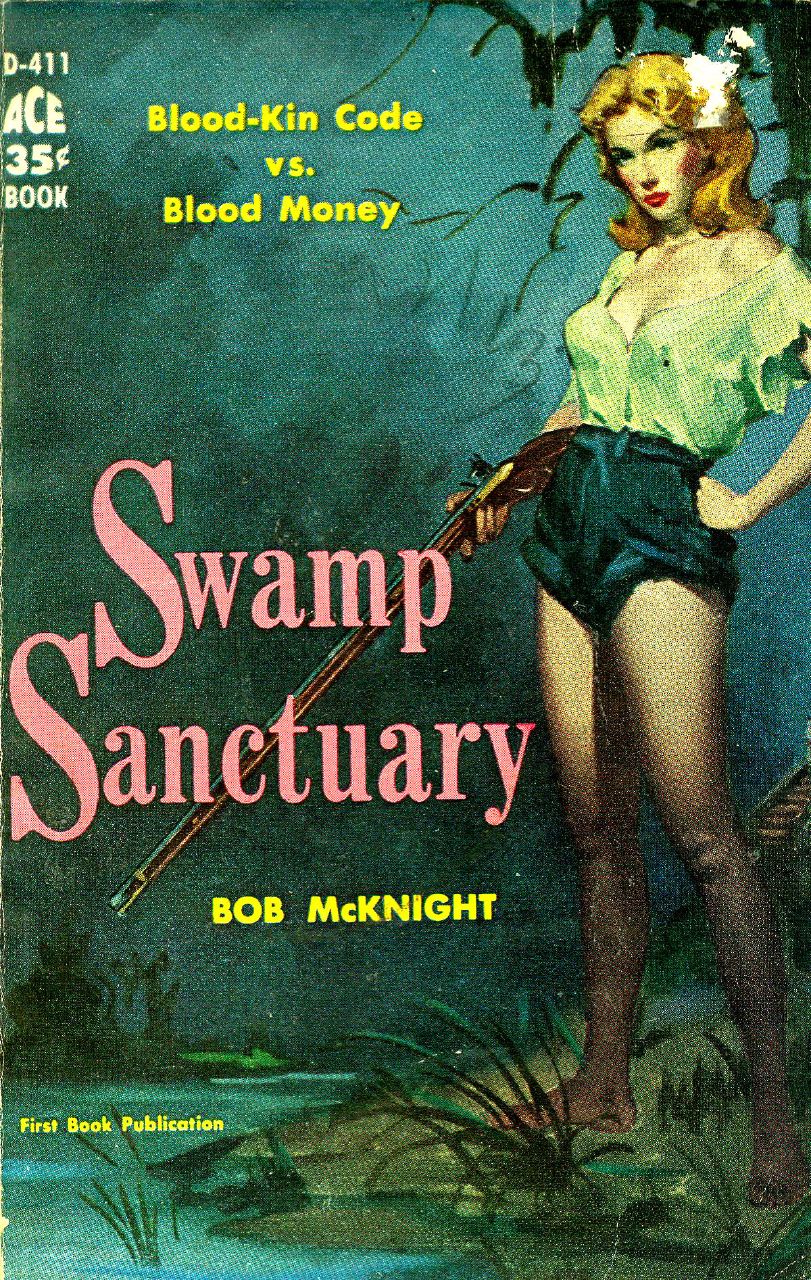
Although Trump no longer swears to “drain the swamp” of the nation’s capital, that phrase got me to thinking recently about how often the word “swamp” and swamp imagery have appeared on vintage paperback novels. The examples embedded in this post aren’t all that might be found, but they’re certainly representative of the field. Among the artists whose work appears here are Robert Bonfils (Swamp Bred), James Meese (Swamp Babe), Barye Phillips (Swamp Brat), Lou Marchetti (the second version of Evans Wall’s Swamp Girl shown below), and George Mayers (Castles in the Swamp).
Click on any of these images for an enlargement.


Subscribe to:
Posts (Atom)