Showing posts with label John D MacDonald. Show all posts

Wednesday, January 29, 2025

Pull Up a Chair and Stay Awhile


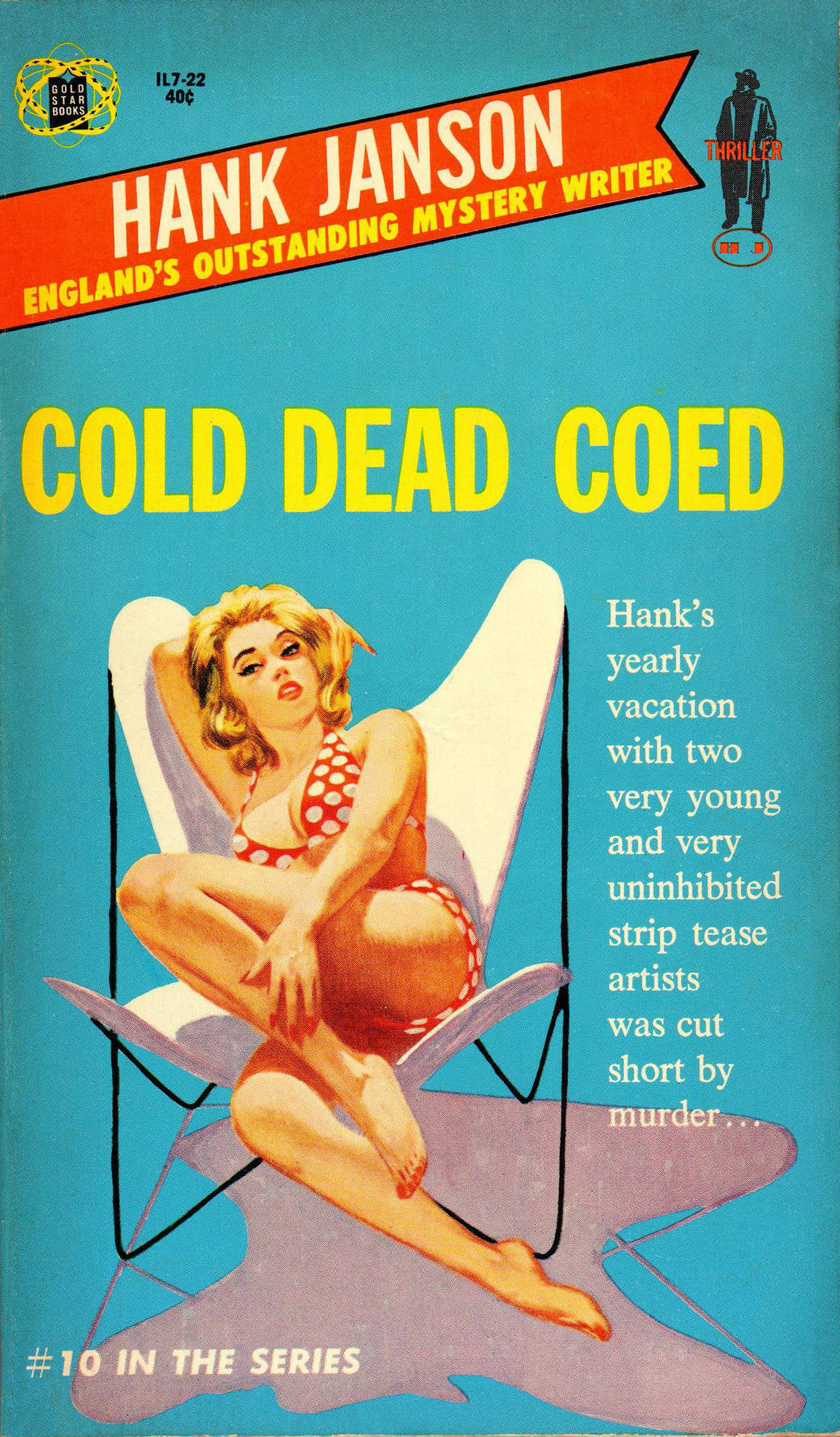
Every once in a while I need to revisit a theme here in Killer Covers. Today, it’s the use of butterfly chairs on paperback fronts.

My first gallery of such covers was posted way back in 2015. Seven years later, I included butterfly chairs in a CrimeReads feature focused on “seven colorful cover themes from crime fiction’s past.” Now I bring you a couple of new examples fitting this motif, plus three that I didn’t include in the 2015 Killer Covers selection.

The image shown above comes from Counterfeit Kill, a 1963 Gold Medal release attributed to “Gordon Davis,” which was one of several pseudonyms employed by E. Howard Hunt (later infamous for his role in Richard Nixon’s Watergate scandal). The artwork for that standalone novel is attributed to the great Mitchell Hooks. Meanwhile, Harry Barton created the front of Hank Janson’s Cold Dead Coed (Gold Star, 1964). The cover image for Tudor from Lesbos (Beacon, 1964) is regrettably uncredited. Murder on Ice (Ensign, 1973), by “Michael Bardsley,” aka Anthony Nuttall, carries an illustration by Spanish comics artist Manfred Sommer. And Hooks was again behind the cover of John D. MacDonald’s On the Make (Dell, 1960).

If I owned a butterfly chair, I’d happily sit back in it and fully appreciate all five of these vintage works.


Tuesday, April 18, 2023

Another Look: “Border Town Girl”

Warning: Artistic inspiration drawn from book titles may vary.


Left: Border Town Girl, by John D. MacDonald (Fawcett Gold Medal, 1956), with a typically sexy cover illustration by Robert McGinnis. Right: Border Town Girl, by John D. MacDonald (Robert Hale, UK, 1970); cover art by Barbara Walton. It was a mention in Mike Ripley’s “Getting Away with Murder” column for Shots that reminded me of this “fast-moving tale.”

Thursday, April 28, 2022

Entertainments Elsewhere

Sorry for the notable recent silence on this page, but I have a good excuse. As I explained in The Rap Sheet, just over a month ago I took a bad fall, leaving me with a concussion exacerbated by a subdural hematoma. My recovery was slow, but steady, and left me unable for a long time to sit in front of my computer and write much. Only recently have I started to catch up a bit with editorial obligations, though I still have much more to accomplish in the short term.

I am working on an extended project for Killer Covers, which should roll out soon. Meanwhile, here are a few links worth mentioning.

• In Dark City Underground, Ben Boulden recalls all 21 of John D. MacDonald’s renowned Travis McGee novels, using book covers.

• In her Euro Crime blog, Karen Meek this month recalled the 110th anniversary of the British ocean liner Titanic’s sinking with a selection of novels in which that tragedy is featured. There are so many more examples she might have cited.

• Amid Russia’s recent saber-rattling about the use of nuclear weapons in Eastern Europe, I recalled Pulp International’s 2017 display of “mid-century book covers featuring nuclear explosions.”

• And do you remember “stepback covers”? As the blog Sweet Savage Flame explains, they were also known as “tip-ins”—slick pages inserted into paperback books after the binding process, which helped create a secondary artistic spread behind the front cover. Tip-ins were frequently used in late-29th-century genre fiction (especially romance novels), allowing “the respectable-looking outer portion of the cover [to hide] the more ‘lurid’ illustration beneath.” Part I of Sweet Save Flame’s history of stepbacks can be found here, with links to the full series at the bottom of that post.

Thursday, February 7, 2019

Because I Needed a MacDonald Fix …


The Lethal Sex, edited by John D. MacDonald (Dell, 1959).
Cover illustration by Robert McGinnis.

Wednesday, June 13, 2018

The Lesser Look: “The Quick Red Fox”

Part of a month-long celebration of Ron Lesser’s artistic legacy.


The Quick Red Fox, by John D. MacDonald (Fawcett Gold Medal, 1964). This is the fourth entry in MacDonald’s Travis McGee series. The main cover art is by Ron Lesser, but the inset portrait of McGee was done by John McDermott.

Monday, May 28, 2018

The Lesser Look: “Bright Orange for the Shroud”

Part of a month-long celebration of Ron Lesser’s artistic legacy.


Bright Orange for the Shroud, by John D. MacDonald (Fawcett Gold Medal, 1965). This is the sixth entry in MacDonald’s Travis McGee series. The main cover art is by Ron Lesser, but the inset portrait of McGee was done by John McDermott.

Thursday, August 24, 2017

Quick Takes

This is a weird French paperback front. According to the Seattle Mystery Bookshop’s Hardboiled blog, it’s from the 1955 Presses de la Cité edition of Marée fraiche (Fresh Tide in English), by J.R. MacDonald—otherwise known as John Ross Macdonald, who eventually became known simply as Ross Macdonald. In the States, this book appeared under the title Dead Low Tide (1953) and was credited not to the creator of the Lew Archer private eye series, but instead to its actual author, John D. MacDonald. Stories have it that John D. MacDonald, who gave the world the Travis McGee series (which did not include Dead Low Tide), was upset when Canada-born California wordsmith Kenneth Millar adopted the nom de plume John Macdonald, later John Ross Macdonald, for his early non-Archer yarns. His attitude toward the competition could hardly have been improved by seeing Dead Low Tide—said to be John D.’s “first great novel”—misidentified in France as another writer’s work.

• Speaking of Travis McGee, Ben Boulden features a handsome gallery of covers from MacDonald’s series in Gravetapping.

• Two more wonderful collections, both from Pulp International: This one focuses on book fronts featuring nuclear explosions; while this other one showcases paperbacks showing men trying to kiss the skin off women’s necks. I wish I’d thought of both themes first!

• The Book Bond brings word that publisher Vintage Classics is preparing yet another fresh array of covers for Ian Fleming’s James Bond novels, to debut in Great Britain this coming November. Learn more about those editions on the Fleming Web site.

• Euro Crime highlights a recent design trend likely to spread further than just three book fronts: black and yellow color combos.

• And though its release isn’t due till 2018, you can already enjoy Laurel Blechman’s sexy cover illustration for The Last Stand, described as the final novel Mickey Spillane completed before his death in 2006. (Actually, this Hard Case Crime edition will contain both that standalone story and a previously unpublished novella, A Bullet for Satisfaction.) Click here to read an excerpt from The Last Stand, and for an enlargement of the cover, look here.

Sunday, July 10, 2016

MacDonald’s Century: From Pulps to Popularity


If you read yesterday’s piece by Jay Handelman in Florida’s Sarasota Herald-Tribune, or have been keeping track of that newspaper’s evolving “John D. and Me” series, you already know that July 24 will mark 100 years since the birth, in Sharon, Pennsylvania, of John D. MacDonald (1916-1986), the well-respected and fervently praised author of a 21-book series starring Florida “salvage consultant”/investigator Travis McGee.

To celebrate this notable occasion, Killer Covers is planning to post two weeks worth of vintage MacDonald book fronts, taken not only from his McGee series, but from the many other crime, suspense, and science-fiction novels he composed. Many of those façades are lovely, and we won’t be able to get to them all. But we hope that the ones slated to appear on this page will remind you of the fine work MacDonald did over his more than three-decades-long career, and perhaps encourage you to dig further into his oeuvre.

Let’s begin, quite appropriately, with The Brass Cupcake (Gold Medal, 1950), the first book-length manuscript MacDonald saw published, after years spent penning hundreds of short stories and novellas. As Steve Scott recalls in his blog, The Trap of Solid Gold, at the time, paperback publisher Fawcett was hungry for original works. “MacDonald had an already-written novella titled ‘The Brass Cupcake’ and intended it for publication in one of the pulps. His agent made the suggestion that JDM lengthen it and shop it to Fawcett as a paperback original. Rather than simply padding the original work, MacDonald rewrote it and it became his first published novel …” The art for the cover shown above was painted by Barye Phillips.

READ MORE:The Brass Cupcake, by John D. MacDonald,” by Andrew Cartmel (Narrative Drive).

Friday, May 6, 2016

Florida Son

How did readers come by their image of Florida “salvage consultant”/investigator Travis McGee? Steve Scott answers that question in The Trap of Solid Gold:
Once John D. MacDonald made the decision to create the series character Travis McGee, he wrote three versions of the first novel before coming up with a person he could “live with.” He sent the book off to his editor at Fawcett Gold Medal, Knox Burger, with the request to hold off publishing it until he could come up with some additional adventures, and once he had three done the go-ahead was given to begin publishing. Then began the editorial preparations for publication, including cover art.

In what seems like an unusual move, Burger chose to have the early covers illustrated by two different artists: one for the main cover and one for an inset of a portrait of McGee himself. Why this was done is anybody’s guess at this point, although I’m sure there is evidence among the MacDonald papers at the University of Florida. Perhaps a clue can be found in the particular artists Burger chose to do these covers, Ron Lesser and, for the likeness of McGee, John McDermott.

Both had done work for Gold Medal up to that point in late 1963, but McDermott was responsible for doing the covers of another crime series, Donald Hamilton’s Matt Helm. Beginning with the sixth entry in the series,
The Ambushers, published in 1963, McDermott took over the cover duties and began adding an inset depiction of Helm. When Fawcett began reprinting earlier titles they had McDermott create new illustrations along with his version of Helm. This was right around the time that MacDonald was submitting his manuscripts of the McGee novels, and I guess Burger thought it a good idea to have McDermott do the same for McGee. Why he chose Lesser to do the covers proper—always a beautiful girl in some unusual pose—and not McDermott is not known. Perhaps he didn’t want the two series to become confused in the minds of his customers.
You can read Scott’s full piece here.

Wednesday, April 27, 2016

Potpourri of Posts

• Steve Scott, at the John D. MacDonald blog The Trap of Solid Gold, looks back at “Kitten on a Trampoline,” one the most famous and delightful combinations of MacDonald’s fiction and Robert McGinnis’ artwork. The short story “Kitten on a Trampoline,” he notes, “appeared only once”—in the April 8, 1961, issue The Saturday Evening Post—“and has never been anthologized or republished.”

• Prior to the recent start of his “hiatus,” British Columbia blogger Noah Stewart began putting together fascinating galleries of the various covers used on classic works of mystery fiction. Here, for instance, are examples of the fronts you can find from The Rasp, Philip Macdonald’s 1924 novel. And click here to see a wide variety of façades that have decorated The Red Box (1937), Rex Stout’s fourth Nero Wolfe novel. I hope Stewart will be back soon with more of these “Cover Art Through the Ages” posts.

• The newest Web site to imagine funny/wicked/wonderful new titles for older novels is a Twitter page called Paperback Paradise. Both Mashable and BuzzFeed have recently gathered together Paperback Paradise’s parodies of once-innocent children’s books.

• Pulp International offers a beautiful cover from I Like It Tough, James A. Howard’s 1955 novel—the “powerful story of a reporter destroying a vicious dope ring.” It’s one of Howard’s tales featuring Steve Ashe, who also appeared in such works as I’ll Get You Yet (1954), Blow Out My Torch (1956), and Die on Easy Street (1957).

• Finally, check out Gravetapping’s enjoyable “Thrift Shop Book Covers” posts. Blogger Ben Boulden has so far featured works by Ralph Dennis, Gavin Lyall, Richard Stark, and Isaac Asimov.

Friday, October 2, 2015

Friday Finds: “Murder in the Wind”

Another in our growing line of vintage book covers we love.


Murder in the Wind, by John D. MacDonald (Dell, 1956).
Illustration by George Gross.

You should have no difficulty guessing what inspired this week’s “Find.” That’s right, it’s Hurricane Joaquin, the 10th named storm of the 2015 Atlantic hurricane season. As I compose this post, Joaquin has pretty much stalled over the Bahamas, battering those islands with gales and downpours, but it still threatens America’s East Coast with “heavy rain and potential flooding” in days to come.

John D. MacDonald’s Murder in the Wind (1956, also printed as Hurricane) is set in Florida, and it’s one of several novels he wrote about people thrown together by adversity--with dangerous results. Steve Scott, who writes the exceptional MacDonald blog, A Trap of Solid Gold, outlines the book’s plot this way:
Six carloads of people--two driving solo while the rest [come] in cars of twos, threes and fours--are driving north on Florida Route 19 above Tampa, all on business, personal or otherwise, that will take them out of the state. They are a random group who are still strangers to each other, and like MacDonald’s previous novels with a similar structure, all are moving by automobile. The “adversity” here is Hurricane Hilda, which is forming itself into a storm of historic strength far out in the Gulf of Mexico, a fact nearly unknown to all in the pre-weather satellite days of 1956. By the time they have reached the Waccasassa River the bridge there is out and they are directed down a remote bypass road that passes an old, rambling and now deserted house. With the storm increasing in strength and passing directly over them, they can go no further and all seek shelter in the abandoned house. …

In virtually all of MacDonald's multi-character novels there is a criminal element, and
Murder in the Wind is no exception. Among the author’s little group of cars heading north is a stolen panel truck containing three young bad guys, two males and a female.
All of the ingredients for reader engagement are here, including murder. But Scott says Macdonald set himself a bigger challenge with this tale than simply driving readers to the edges of their seats.
MacDonald is at pains to prove the plausibility of such a strong storm, years before names like Donna, Andrew and Katrina were written in history, providing a brief “Author’s Note” at the beginning of the book and interspersing the narrative with omniscient updates on the track and power of the storm. And while it is obvious to the reader that the hurricane and the characters will eventually “meet,” Murder in the Wind is primarily a suspense novel, with the tension provided by the deep characterization created by the author. I’ve written endlessly in this blog about how MacDonald’s apprenticeship as a short-story writer made him the perfect author for these kinds of multi-character tales, and nowhere is that more true than in this novel. All of the characters--roughly ten in all--are each given a history and background as interesting and as engaging as any in his best shorter works, and it is through this incredibly detailed characterization that MacDonald drives narrative, that attribute of fiction he held in the highest esteem.
Three years ago, Deep South Magazine, an online publication, posted a list of “books to read during a hurricane.” It included a better-remembered MacDonald work, Cape Fear (originally published in 1957 as The Executioners). The editors could just as well, though, have selected Murder in the Wind, which acclaimed author and critic Ed Gorman has named as one of his “10 Favorite John D. MacDonald Standalone Novels.” (Topping Gorman’s list is 1953’s Dead Low Tide; Murder in the Wind ranks fourth.) And had they been in possession of the 1956 original-edition paperback of Murder in the Wind, MacDonald’s 18th novel--shown at the top of this post--they might have been persuaded to do exactly that. It certainly boasts a striking cover, with an attractive brunette obviously at risk from escalating currents. Responsible for the illustration was George Gross (1909-2003), about whom I have written before on this page, and whose range of paperback artistry can be enjoyed here.


BONUS: Over the last several decades some other noteworthy illustrators have taken cracks at creating captivating covers for Murder in the Wind. The front on the left, for instance, was painted by Robert K. Abbett and appeared on the 1960 Dell edition, while the one shown on the right, from the 1965 Fawcett edition of MacDonald’s novel, features an illustration by Robert McGinnis.

Wednesday, October 29, 2014

Month of McGinnis: “The Dreadful Lemon Sky”

Part of a month-long celebration of Robert McGinnis’ book covers.


The Dreadful Lemon Sky, by John D. MacDonald (Fawcett, 1975).

As Chris Ogle explains in his blog, John D. MacDonald Covers: “This was the Big One. John D MacDonald’s first best seller. This one put him on the map. The book was so popular that Fawcett redesigned every other JDM book in print to promote Lemon, each with the same Seventies-looking font for his name. Robert McGinnis again. Not his best effort ever, but probably one [of] his best known.”

Tuesday, October 7, 2014

Two-fer Tuesdays: Costs and (Death) Benefits

A twice-monthly pairing of book covers that just seem to go together. Click on either of these images to open up an enlargement.


So let’s take a short break from Killer Covers’ month-long tribute to artist Robert McGinnis, and instead ooh and ahh over a couple of other paperback book fronts I’ve had tucked away in my files for some while. The façade on the left comes from the 1968 Fawcett Gold Medal edition of The Price of Murder, by John D. MacDonald (a work originally published in 1957). As Steve Scott recalls in his excellent blog, The Trap of Solid Gold--recently reinvigorated after a much-too-long hiatus--The Price of Murder was Macdonald’s 20th novel, a standalone paperback original. He explains that
The basic plot of the novel is centered around a MacGuffin: nearly half a million dollars in hot cash that originated as ransom for two young children who were kidnapped, never returned and who were later found murdered. The offspring of a Houston millionaire, the young boys’ kidnapping became a newspaper sensation once their bodies were found and it was revealed that all of the ransom cash--small-denomination bills--had been recorded and was traceable, making it virtually un-spendable. This fact was unknown to the kidnappers before the boys’ bodies were found, and they were quickly located in a small farmhouse near Orangeville, Pennsylvania (where JDM’s parents owned a summer home when John was a young boy). After a gun battle that left the three kidnappers dead, a portion of the ransom loot--one-hundred and sixty-five thousand dollars--was recovered, leaving the location of the remaining $327,000 a mystery. In the chaos of the gun battle a county cop grabbed one of two suitcases containing the money and hid it, afraid to try and spend or move it for over a year. Eventually he sold it to an underworld contact for $10,000, who then sold it to a Cleveland speculator who eventually became uncomfortable with it and unloaded it to a Detroit mobster for $15,000. But like all of the previous owners, the Detroit man is too scared to try and pass what has now become viewed as cursed money, and a widespread superstition among the underworld about the cash is making it difficult for him to get rid of it.
I wish I knew even half as much about the artist responsible for the cover of this 46-year-old paperback as I know, from Scott, about the book’s story line. In his John D. MacDonald Covers blog, Chris Ogle writes that the illustrator is officially unknown. Ogle offers a few compliments about that artist’s work, though: “What a superb cover! The girl is looking directly at the viewer as if she expects help from you. The man’s face is hidden, which makes him even more insidious. The lighting is coming from the upper left which puts her shadowed face in the foreground, a reversal of normal composition. And the hand! Ah, the hand!” Indeed, this front is wonderfully haunting, especially thanks to its teaser: “She was so alive and he needed her so badly, there was nothing to do but kill her …” I hope someday to find a copy of this edition for my own library.

Now let’s consider the image above and to the right. It demonstrates the talent of Sam Cherry, who painted covers for many of the 20th-century pulp mags as well as paperback book covers. In this case, Cherry was introducing the 1952 Popular Library edition of What Price Murder, by Cleve F. Adams. During his career, Adams produced a succession of novels featuring Los Angeles private eye Rex McBride--“one of the most repugnant characters in detective fiction history,” according to a Rara-Avis critic--but What Price Murder, first published by Dutton in 1942, was a non-series yarn. Blogger-author Evan Lewis, who declares himself “a big fan of the Rex McBride series,” briefly describes the plot of this book thusly:
[In-house insurance investigator Stephen] McCloud is racing to recover two million dollars in stolen diamonds-by whatever means necessary--before his boss is forced to pay out on the insurance claim. And it’s tough going. When he’s not getting drunk or chasing women, he’s getting conked on the head, robbed, and running from the cops on suspicion of murder. For an Adams hero, of course, that’s all in a day’s work. And it makes for a fine read.
For all of the violence Steve McCloud might have to endure in this tale, Cherry’s art suggests there’s at least some blond, deep-cleavaged compensation for his trouble.

Saturday, October 4, 2014

Month of McGinnis: “Soft Touch”

Part of a month-long celebration of Robert McGinnis’ book covers.


Soft Touch, by John D. MacDonald (Dell, 1962).

Thursday, July 24, 2014

The Heat Is On: The Beach Girls

Celebrating the delights of summer. Click here for the full set.


The Beach Girls, by John D. MacDonald (Fawcett Gold Medal, 1963). Illustration by Charles Binger.

I’m posting this today in recognition of what would be author MacDonald’s 98th birthday, were he still alive (he died in 1986). A subsequent edition of the same novel can be seen here.

Friday, February 4, 2011

From “Straight” to Stunning

Leif Peng’s focus this week in Today’s Inspiration is commercial, editorial, and pin-up artist Ward Brackett (1914-2006), once an apprentice to Haddon Sunblom. Included in Brackett’s portfolio were magazine illustrations for John D. Macdonald stories. You will find out more here, here, here, and here.